
Distance Calculator-A Distance Calculator helps you quickly find the distance between two places, cities, locations, or points. Depending on the type of calculation, distance can be measured in kilometers (km), miles (mi), meters (m), feet (ft), or other units. Explore our free online calculator tools for ,Surface Area Calculator,Right Triangle Calculator quick answers across different categories.
📏 2D Distance Calculator CalculatorGuides
Point 1 (X1, Y1)
Point 2 (X2, Y2)
🌐 3D Distance Calculator CalculatorGuides
Point 1 (X1, Y1, Z1)
Point 2 (X2, Y2, Z2)
Using Haversine Formula (Decimal Degrees)🌍 Lat/Long Distance Calculator CalculatorGuides
Point 1
Point 2
Whether you want to know the distance between two cities, calculate the distance between two points, find the distance you need to travel, or convert kilometers to miles, a distance calculator can give you a quick answer without requiring complicated math.
Distance can be measured in different ways. For example, the distance between two cities on a map may be different from the actual driving distance because roads do not always follow a straight path.
This guide explains how a distance calculator works, the different types of distance, common formulas, distance units, examples, and practical ways to calculate distance.
What Is a Distance Calculator?
A Distance Calculator is a tool that calculates the distance between two locations, points, or objects.
The calculation depends on what you are measuring.
For example:
- Distance between two cities
- Distance between two addresses
- Distance between two points
- Distance between two coordinates
- Driving distance
- Straight-line distance
- Distance in kilometers
- Distance in miles
- Distance traveled
- Distance between GPS locations
A simple distance calculator can be useful for travel, geography, mathematics, fitness, mapping, education, and everyday planning.
How Does a Distance Calculator Work?
A distance calculator uses different methods depending on the information you provide.
If you enter two numerical values, the calculator may simply find the difference between them.
For example:
Distance = Final Position − Starting Position
If you travel from 20 km to 75 km:
75 − 20 = 55 km
So the distance is 55 km.
For locations on Earth, the calculation can be more complicated because the Earth is curved. In this case, a calculator may use the latitude and longitude of both locations.
For road travel, the calculation may use the actual road route rather than a straight line.
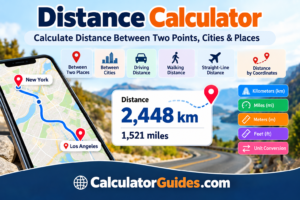
Types of Distance
There is more than one way to measure distance. Understanding the difference is important because two distance calculations can give different results.
1. Straight-Line Distance
Straight-line distance is the shortest distance between two points.
Imagine drawing a straight line from one location to another. The length of that line is the straight-line distance.
It is sometimes called:
- Direct distance
- As-the-crow-flies distance
- Geographical distance
- Air distance
For example, two cities may be 200 km apart in a straight line but 240 km apart by road.
2. Driving Distance
Driving distance is the distance you actually travel using roads.
It can be longer than the straight-line distance because roads:
- Curve
- Follow highways
- Avoid buildings
- Cross rivers
- Follow mountains
- Use bridges
- Connect through different routes
For example:
Straight-line distance: 180 km
Driving distance: 215 km
If you are planning a road trip, driving distance is usually more useful than straight-line distance.
3. Distance Between Two Cities
A distance calculator can be used to compare two cities.
For example, you may want to know:
- Distance from Delhi to Mumbai
- Distance from New York to Los Angeles
- Distance from London to Manchester
- Distance from Paris to Berlin
The answer can be provided as either straight-line distance or travel distance, depending on the calculation method.
4. Distance Between Two Points
In mathematics, distance between two points can be calculated using their coordinates.
If two points are:
A = (x₁, y₁)
B = (x₂, y₂)
The distance formula is:
Distance = √[(x₂ − x₁)² + (y₂ − y₁)²]
This formula is commonly used in geometry, coordinate geometry, physics, and mathematics.
Distance Formula
The basic distance formula depends on the situation.
For two points on a two-dimensional coordinate plane:
d = √[(x₂ − x₁)² + (y₂ − y₁)²]
Where:
- d = distance
- x₁ = x-coordinate of the first point
- y₁ = y-coordinate of the first point
- x₂ = x-coordinate of the second point
- y₂ = y-coordinate of the second point
Example
Suppose:
Point A = (2, 3)
Point B = (8, 11)
First find the differences:
8 − 2 = 6
11 − 3 = 8
Now calculate:
d = √(6² + 8²)
d = √(36 + 64)
d = √100
d = 10
Therefore, the distance between the two points is:
10 units
Distance Between Two GPS Coordinates
When calculating the distance between two locations on Earth, latitude and longitude are commonly used.
Because Earth is approximately spherical, a simple flat-plane distance formula is not always accurate for locations that are far apart.
One commonly used method is the Haversine formula.
The Haversine formula calculates the great-circle distance between two points on a sphere.
The general formula is:
a = sin²(Δφ/2) + cos(φ₁) × cos(φ₂) × sin²(Δλ/2)
Then:
c = 2 × atan2(√a, √(1 − a))
And:
d = R × c
Where:
- φ = latitude
- λ = longitude
- R = Earth’s radius
- d = distance
You normally do not need to calculate this manually. A distance calculator can perform the calculation automatically.
Kilometers and Miles
Two of the most commonly used distance units are kilometers and miles.
1 Kilometer to Miles
1 km ≈ 0.621371 miles
1 Mile to Kilometers
1 mile ≈ 1.609344 km
Quick Conversion Table
| Kilometers | Miles |
|---|---|
| 1 km | 0.62 mi |
| 5 km | 3.11 mi |
| 10 km | 6.21 mi |
| 20 km | 12.43 mi |
| 50 km | 31.07 mi |
| 100 km | 62.14 mi |
| 500 km | 310.69 mi |
| 1,000 km | 621.37 mi |
These values are useful when comparing distances between countries that use different measurement systems.
Miles to Kilometers Conversion
To convert miles to kilometers, multiply the number of miles by 1.609344.
Formula
Kilometers = Miles × 1.609344
Example
Suppose you have:
50 miles
Then:
50 × 1.609344 = 80.4672 km
So:
50 miles ≈ 80.47 km
Kilometers to Miles Conversion
To convert kilometers to miles, multiply kilometers by 0.621371.
Formula
Miles = Kilometers × 0.621371
Example
For 100 km:
100 × 0.621371 = 62.1371 miles
Therefore:
100 km ≈ 62.14 miles
Distance Units
Distance can be measured using many different units.
Common units include:
- Millimeters (mm)
- Centimeters (cm)
- Meters (m)
- Kilometers (km)
- Inches (in)
- Feet (ft)
- Yards (yd)
- Miles (mi)
- Nautical miles (nmi)
The correct unit depends on the size and type of distance being measured.
Meters
A meter is commonly used for relatively short distances.
Examples include:
- Room length
- Running track measurements
- Height
- Building dimensions
1 kilometer = 1,000 meters
Centimeters
Centimeters are useful for small measurements.
1 meter = 100 centimeters
For example, the length of a table may be measured in centimeters.
Feet
Feet are commonly used in countries and industries that use the imperial measurement system.
For example:
- Room dimensions
- Building measurements
- Height
- Construction
1 foot = 12 inches
Yards
A yard is equal to:
3 feet
Yards are commonly used for some sports and field measurements.
Miles
Miles are commonly used for longer distances in countries such as the United States.
For example:
- Distance between cities
- Road trips
- Driving distances
- Running routes
Nautical Miles
A nautical mile is mainly used for navigation and aviation.
1 nautical mile = 1,852 meters
Nautical miles are commonly used in:
- Marine navigation
- Aviation
- Shipping
Distance Between Two Places
When people search for the distance between two places, they may mean different things.
For example, they might want:
Straight-line distance
or
Driving distance
These are not always the same.
Suppose two locations are separated by a river or mountain range. The straight-line distance may be relatively short, but the road route may need to travel around the obstacle.
This is why it is important to know which type of distance you need.
Distance Between Two Cities
A city-to-city distance can be measured in several ways.
Straight-Line City Distance
This measures the direct geographical distance between the cities.
Road Distance
This measures the distance along available roads.
Travel Distance
This refers to the actual route you plan to travel and may change depending on the selected roads.
For travel planning, road distance is generally more useful because it reflects the route you can actually take.
Distance vs Displacement
Distance and displacement are related but not identical.
Distance
Distance describes the total path traveled.
It is a scalar quantity, meaning it has magnitude but no direction.
Displacement
Displacement describes the change from the starting position to the final position and includes direction.
Example
Imagine you walk:
- 5 km east
- Then 5 km west
Your total distance traveled is:
10 km
But your final position is the same as your starting position.
Therefore, your displacement is:
0 km
This difference is important in physics.
Distance Calculator for Travel
A distance calculator can be useful when planning a journey.
You may want to know:
- How far two cities are apart
- How many kilometers you need to drive
- How many miles you need to travel
- Whether a destination is close or far
- Approximate travel distance
- Distance between multiple locations
Knowing the distance can also help you estimate fuel requirements, travel time, and trip costs.
Distance and Travel Time
Distance and travel time are connected through speed.
The basic formula is:
Time = Distance ÷ Speed
For example, if you travel 240 km at an average speed of 80 km/h:
Time = 240 ÷ 80
Time = 3 hours
So the theoretical travel time is 3 hours.
However, real travel can take longer because of:
- Traffic
- Stops
- Road conditions
- Weather
- Speed limits
- Construction
- Rest breaks
Therefore, distance alone does not tell you the exact travel time.
Distance, Speed, and Time Formula
The three basic formulas are:
Distance
Distance = Speed × Time
Speed
Speed = Distance ÷ Time
Time
Time = Distance ÷ Speed
These formulas are commonly used in mathematics and physics.
Example
If a car travels at 60 km/h for 4 hours:
Distance = 60 × 4
Distance = 240 km
Therefore, the car travels 240 km if it maintains that speed for the entire four hours.
Distance Calculator for Running and Walking
Distance calculators are also useful for fitness activities.
For example, runners and walkers may want to know:
- How far they walked
- How far they ran
- Kilometers completed
- Miles completed
- Distance remaining
- Distance converted from miles to kilometers
Common running distances include:
- 1 km
- 3 km
- 5 km
- 10 km
- Half marathon
- Marathon
A distance calculator can help convert between kilometers and miles.
Common Running Conversions
5 km ≈ 3.11 miles
10 km ≈ 6.21 miles
21.1 km ≈ 13.11 miles
42.195 km ≈ 26.22 miles
Distance Calculator for Cycling
Cyclists can also use distance calculations to understand their routes.
For example, a cyclist may track:
- Total kilometers
- Total miles
- Average speed
- Estimated travel time
- Distance remaining
If a cyclist travels 30 km at an average speed of 20 km/h:
Time = 30 ÷ 20
Time = 1.5 hours
That is approximately:
1 hour 30 minutes
Distance Calculator for Maps
Maps can show distance in different ways.
A map may provide:
- Straight-line distance
- Road distance
- Walking distance
- Cycling distance
- Driving distance
The best measurement depends on what you are trying to find.
If you are simply comparing the geographical position of two locations, straight-line distance can be useful.
If you are traveling, road distance is usually more relevant.
How to Calculate Distance Manually
The method depends on the type of distance.
For Simple Numerical Positions
Use:
Distance = |Final Position − Starting Position|
The vertical bars mean that the result should be positive.
Example:
Starting position = 15 km
Final position = 42 km
Distance = |42 − 15|
Distance = 27 km
For Two Coordinate Points
Use:
d = √[(x₂ − x₁)² + (y₂ − y₁)²]
This is the standard two-dimensional distance formula.
For Earth Coordinates
Use a geographical distance formula such as the Haversine formula.
For everyday use, an online calculator is much easier because it handles the mathematical steps automatically.
Why Can Two Distance Calculators Give Different Results?
Two calculators may show different distances because they are measuring different things.
For example:
Calculator A: Straight-line distance
Calculator B: Driving distance
Both results can be correct because they answer different questions.
Other reasons include:
- Different map data
- Different road routes
- Different starting points
- Different destination points
- Updated roads
- Route restrictions
- Geographic calculation methods
Always check whether the result is a straight-line distance or travel distance.
Distance Calculator Example
Suppose you want to calculate the distance between two points:
Point A = (4, 2)
Point B = (10, 10)
Use the distance formula:
d = √[(10 − 4)² + (10 − 2)²]
d = √(6² + 8²)
d = √(36 + 64)
d = √100
d = 10
The distance between the points is:
10 units
This type of calculation is useful for coordinate geometry and mathematics.
Common Distance Conversions
Here are some useful conversions:
| Unit | Equivalent |
|---|---|
| 1 km | 1,000 m |
| 1 mile | 1.609344 km |
| 1 km | 0.621371 miles |
| 1 meter | 100 cm |
| 1 foot | 12 inches |
| 1 yard | 3 feet |
| 1 mile | 5,280 feet |
| 1 nautical mile | 1.852 km |
Distance Calculator for Students
Students may use distance calculations in:
- Mathematics
- Geometry
- Physics
- Geography
- Science
- Coordinate geometry
Common questions include:
- How do you calculate distance?
- What is the distance formula?
- How do you find distance between two points?
- How do you convert miles to kilometers?
- How do you calculate distance using speed and time?
Learning the basic formulas makes these calculations much easier.
Distance Formula in Physics
In physics, distance can be calculated from speed and time.
The basic equation is:
d = s × t
Where:
- d = distance
- s = speed
- t = time
For example:
Speed = 50 m/s
Time = 20 seconds
Then:
Distance = 50 × 20
Distance = 1,000 meters
So the object travels 1,000 meters.
What Is the Difference Between Distance and Road Distance?
Distance can refer to the direct measurement between two points.
Road distance follows the actual road network.
For example, two locations may be 100 km apart in a straight line but require a 125 km road journey.
If you are planning a trip, always check the road distance rather than relying only on straight-line distance.
How Accurate Is a Distance Calculator?
The accuracy depends on the type of calculation.
For mathematical coordinates, the result can be highly precise.
For geographical distances, accuracy depends on:
- Coordinate accuracy
- Earth’s model
- Map data
- Route information
- Starting and ending locations
Road distance can also change when roads or routes change.
For everyday planning, a good distance calculator provides a useful estimate, but actual travel conditions can differ.
Common Mistakes When Calculating Distance
1. Mixing Miles and Kilometers
A distance of 100 miles is not the same as 100 kilometers.
Always check the unit.
2. Confusing Straight-Line and Road Distance
A map’s direct distance may be much shorter than the actual driving route.
3. Using the Wrong Formula
The coordinate distance formula is different from the speed-distance-time formula.
4. Forgetting Units
A result such as “50” is incomplete without knowing whether it means:
- 50 meters
- 50 kilometers
- 50 miles
5. Using Incorrect Coordinates
Even a small coordinate error can affect geographical distance calculations.
Frequently Asked Questions About Distance Calculator
What is a distance calculator?
A distance calculator is a tool that calculates the distance between two points, locations, cities, or coordinates.
How do you calculate distance?
The formula depends on the situation. For two coordinate points, use:
d = √[(x₂ − x₁)² + (y₂ − y₁)²]
For speed and time:
Distance = Speed × Time
How many miles are in 1 kilometer?
One kilometer is approximately 0.621371 miles.
How many kilometers are in 1 mile?
One mile is exactly 1.609344 kilometers.
What is the difference between distance and displacement?
Distance is the total path traveled, while displacement is the change in position from the starting point to the final point, including direction.
Is driving distance the same as straight-line distance?
No. Driving distance follows roads, while straight-line distance measures the direct distance between two locations.
How do I calculate the distance between two cities?
You can use their geographical coordinates to calculate straight-line distance or use road-route information to calculate driving distance.
What formula is used to find distance between two points?
For two points on a coordinate plane:
d = √[(x₂ − x₁)² + (y₂ − y₁)²]
Can distance be measured in miles and kilometers?
Yes. Distance can be measured in many units, including miles, kilometers, meters, feet, yards, and nautical miles.
How do I convert kilometers to miles?
Multiply kilometers by 0.621371.
Miles = Kilometers × 0.621371
How do I convert miles to kilometers?
Multiply miles by 1.609344.
Kilometers = Miles × 1.609344
What is the distance formula in physics?
The basic formula is:
Distance = Speed × Time
when speed is constant.
Can I calculate walking distance?
Yes. A distance calculator can be used to determine how far a walking route is, although an actual map route may provide a more accurate walking distance.
Can I calculate driving distance?
Yes. Driving distance follows the road route between two locations and may be longer than the direct geographical distance.
Why is my calculated distance different from a map?
The difference may be because one result measures straight-line distance while the other measures road distance. Different routes and map data can also produce different results.
Quick Distance Reference
Distance Formula
Distance = Speed × Time
Time Formula
Time = Distance ÷ Speed
Speed Formula
Speed = Distance ÷ Time
Coordinate Distance
d = √[(x₂ − x₁)² + (y₂ − y₁)²]
Kilometer to Miles
Miles = Kilometers × 0.621371
Miles to Kilometers
Kilometers = Miles × 1.609344
Important Conversion
1 km = 1,000 meters
1 mile = 1.609344 km
1 nautical mile = 1.852 km
When Should You Use a Distance Calculator?
A distance calculator can be useful whenever you need to quickly understand how far something is.
You can use it for:
- Travel planning
- Road trips
- Walking routes
- Running
- Cycling
- Geography
- School projects
- Mathematics
- Physics
- Coordinate calculations
- Distance conversions
- City-to-city comparisons
- GPS calculations
- Navigation
- Fitness tracking
It saves time and reduces the chance of making calculation mistakes.
Final Thoughts
A Distance Calculator is a simple but useful tool for finding how far two points, cities, locations, or coordinates are from each other.
The important thing to remember is that distance can mean different things. Straight-line distance measures the direct distance between two points, while driving distance follows roads. Mathematical distance may use coordinates, while travel distance depends on the route.
For everyday calculations, the most useful formulas include:
Distance = Speed × Time
and, for two coordinate points:
d = √[(x₂ − x₁)² + (y₂ − y₁)²]
You can also quickly convert between common units such as kilometers and miles.
Whether you are planning a trip, checking the distance between cities, solving a math problem, tracking a workout, or simply converting distance units, a distance calculator makes the process faster and easier.