
Surface Area Calculator-A Surface Area Calculator helps you quickly find the total area covering the outside of a three-dimensional object. It can be useful for school math, geometry, engineering, construction, design, manufacturing, and everyday measurements.Get quick answers using our free online calculators for finance,Pythagorean Theorem Calculator,Right Triangle Calculator measurements, and daily needs.
Ball Surface Area
CalculatorGuides
Surface Area:
Cone Surface Area
CalculatorGuides
Total Surface Area:
Cube Surface Area
CalculatorGuides
Surface Area:
Cylindrical Tank Surface Area
CalculatorGuides
Total Surface Area:
Rectangular Tank Surface Area
CalculatorGuides
Surface Area:
Capsule Surface Area
CalculatorGuides
Surface Area:
Provide any 2 values below:Spherical Cap Surface Area
CalculatorGuides
Cap Surface Area:
Conical Frustum Surface Area
CalculatorGuides
Total Surface Area:
Ellipsoid Surface Area
CalculatorGuides
Approx. Surface Area:
Square Pyramid Surface Area
CalculatorGuides
Total Surface Area:
Instead of working through long formulas by hand, you can enter the measurements of a 3D shape and get the surface area in seconds.
Surface area is usually measured in square units, such as square centimeters (cm²), square meters (m²), square inches (in²), or square feet (ft²).
This guide explains how surface area works, the formulas for common 3D shapes, the difference between total and lateral surface area, examples, unit conversions, and common questions people ask about surface area.
What Is Surface Area?
Surface area is the total area of all the outer surfaces of a three-dimensional object.
Think about a cardboard box. If you wanted to cover the entire outside of the box with paper, you would need to cover every face. The combined area of all those faces is the box’s total surface area.
For example, a cube has six square faces. If each side is 5 cm, the area of one face is:
5 × 5 = 25 cm²
Because a cube has six faces:
6 × 25 = 150 cm²
So, the total surface area is 150 cm².
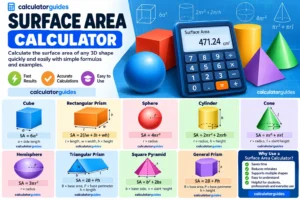
Surface Area Calculator Formula
There is no single formula that works for every 3D shape. The formula depends on the shape you are measuring.
Some common formulas are:
| Shape | Surface Area Formula |
|---|---|
| Cube | 6a² |
| Rectangular Prism | 2(lw + lh + wh) |
| Sphere | 4πr² |
| Cylinder | 2πr² + 2πrh |
| Cone | πr² + πrl |
| Square Pyramid | b² + 2bs |
| Triangular Prism | 2B + Ph |
| Hemisphere | 3πr² |
| Capsule | 2πr² + 2πrh |
Here:
- a = side length
- l = length
- w = width
- h = height
- r = radius
- d = diameter
- l in the cone formula = slant height
- B = area of the base
- P = perimeter of the base
How Does a Surface Area Calculator Work?
A surface area calculator uses the dimensions you provide and applies the correct mathematical formula.
For example, suppose you want to calculate the surface area of a cylinder.
You enter:
- Radius = 5 cm
- Height = 10 cm
The calculator uses:
Surface Area = 2πr² + 2πrh
Substituting the values:
SA = 2π(5²) + 2π(5)(10)
After calculating the result, the surface area is approximately:
471.24 cm²
The calculator saves you from manually repeating the formula and arithmetic.
Total Surface Area vs Lateral Surface Area
One common source of confusion is the difference between total surface area and lateral surface area.
Total Surface Area
Total surface area includes all surfaces of the object.
For a cylinder, this includes:
- Top circular surface
- Bottom circular surface
- Curved side surface
The formula is:
TSA = 2πr² + 2πrh
Lateral Surface Area
Lateral surface area includes only the side surfaces and does not include the top and bottom.
For a cylinder:
LSA = 2πrh
For a cube or rectangular prism, the corresponding concept is often called the lateral area.
Always check which type of surface area a problem is asking for.
Surface Area of a Cube
A cube has six equal square faces.
If the side length is a, the formula is:
Surface Area = 6a²
Example
Suppose a cube has a side length of 8 cm.
First find the area of one face:
8 × 8 = 64 cm²
Then multiply by six:
6 × 64 = 384 cm²
Surface Area = 384 cm²
A surface area calculator can perform this calculation instantly.
Surface Area of a Rectangular Prism
A rectangular prism has six rectangular faces.
Examples include:
- Boxes
- Rooms
- Bricks
- Storage containers
- Rectangular tanks
The formula is:
SA = 2(lw + lh + wh)
Where:
- l = length
- w = width
- h = height
Example
Suppose:
- Length = 10 cm
- Width = 5 cm
- Height = 4 cm
Then:
SA = 2(10×5 + 10×4 + 5×4)
SA = 2(50 + 40 + 20)
SA = 220 cm²
So, the total surface area is 220 cm².
Surface Area of a Sphere
A sphere is a perfectly round three-dimensional object.
Examples include:
- Balls
- Globes
- Spherical tanks
The surface area formula is:
SA = 4πr²
Where r is the radius.
Example
If the radius of a sphere is 7 cm:
SA = 4π(7²)
SA = 196π
Using π ≈ 3.14159:
SA ≈ 615.75 cm²
So the surface area is approximately 615.75 cm².
Sphere Surface Area Using Diameter
If you know the diameter instead of the radius, first find the radius:
r = d ÷ 2
The sphere formula can also be written as:
SA = πd²
because:
4π(d/2)² = πd²
Surface Area of a Cylinder
A cylinder has:
- Two circular bases
- One curved surface
The total surface area formula is:
SA = 2πr² + 2πrh
It can also be written as:
SA = 2πr(r + h)
Where:
- r = radius
- h = height
Example
Suppose:
- Radius = 4 cm
- Height = 10 cm
Then:
SA = 2π(4²) + 2π(4)(10)
SA = 32π + 80π
SA = 112π
Approximately:
351.86 cm²
Curved Surface Area of a Cylinder
If you only want the curved outside of a cylinder, use:
CSA = 2πrh
For example, if:
- r = 4 cm
- h = 10 cm
Then:
CSA = 2π(4)(10)
CSA = 80π
Approximately:
251.33 cm²
This is useful when calculating the material needed to cover only the curved part of a cylindrical object.
Surface Area of a Cone
A cone has a circular base and a curved surface.
The total surface area formula is:
SA = πr² + πrl
or:
SA = πr(r + l)
Where:
- r = radius
- l = slant height
Example
Suppose:
- Radius = 5 cm
- Slant height = 12 cm
Then:
SA = π(5²) + π(5)(12)
SA = 25π + 60π
SA = 85π
Approximately:
267.04 cm²
How to Find the Slant Height of a Cone
Sometimes a problem gives you the cone’s vertical height instead of its slant height.
You can find the slant height using the Pythagorean theorem:
l = √(r² + h²)
For example:
- Radius = 6 cm
- Height = 8 cm
Then:
l = √(6² + 8²)
l = √(36 + 64)
l = √100
l = 10 cm
You can then use the slant height in the cone surface area formula.
Surface Area of a Hemisphere
A hemisphere is half of a sphere.
There are two common surface area calculations.
Curved Surface Area
For only the curved portion:
CSA = 2πr²
Total Surface Area
If the circular base is included:
TSA = 3πr²
Example
If the radius is 5 cm:
TSA = 3π(5²)
TSA = 75π
Approximately:
235.62 cm²
Be careful about whether the question asks for the curved surface or total surface.
Surface Area of a Triangular Prism
A triangular prism has two triangular bases and three rectangular side faces.
A useful formula is:
SA = 2B + Ph
Where:
- B = area of the triangular base
- P = perimeter of the triangular base
- h = length of the prism
First calculate the triangle’s area:
B = ½ × base × triangle height
Then find the perimeter of the triangle and apply the formula.
This method works for triangular prisms with different triangle dimensions.
Surface Area of a Square Pyramid
A square pyramid has:
- One square base
- Four triangular side faces
The formula is:
SA = b² + 2bs
Where:
- b = base side length
- s = slant height
Example
Suppose:
- Base side = 6 cm
- Slant height = 5 cm
Then:
SA = 6² + 2(6)(5)
SA = 36 + 60
SA = 96 cm²
Surface Area of a Prism
For a general prism, the total surface area can be calculated using:
SA = 2B + Ph
Where:
- B = area of one base
- P = perimeter of the base
- h = height or length of the prism
This formula works for many types of prisms, including:
- Triangular prisms
- Rectangular prisms
- Pentagonal prisms
- Hexagonal prisms
The main difference is how you calculate the base area and perimeter.
Surface Area of a Pyramid
For a regular pyramid, a common formula is:
SA = B + ½Pl
Where:
- B = base area
- P = base perimeter
- l = slant height
The first part represents the base, while the second part represents the total area of the triangular side faces.
Surface Area vs Volume
Surface area and volume are related to 3D objects, but they measure different things.
Surface Area
Surface area measures the outside covering of an object.
It uses square units:
- cm²
- m²
- in²
- ft²
Volume
Volume measures the space inside an object.
It uses cubic units:
- cm³
- m³
- in³
- ft³
For example, a box can have:
- Surface area = 220 cm²
- Volume = 200 cm³
These numbers represent different properties, so they should not be confused.
Surface Area Units
Surface area always uses squared units because you are measuring an area.
Common units include:
- Square millimeters (mm²)
- Square centimeters (cm²)
- Square meters (m²)
- Square kilometers (km²)
- Square inches (in²)
- Square feet (ft²)
- Square yards (yd²)
Important Unit Rule
If you change a length unit, you must square the conversion when calculating area.
For example:
1 meter = 100 centimeters
Therefore:
1 m² = 10,000 cm²
It is not 100 cm².
This is a common mistake when converting surface area.
Surface Area Conversion Examples
Square meters to square centimeters
1 m² = 10,000 cm²
Therefore:
5 m² = 50,000 cm²
Square feet to square inches
1 ft² = 144 in²
Therefore:
10 ft² = 1,440 in²
Square yards to square feet
1 yd² = 9 ft²
Therefore:
20 yd² = 180 ft²
How to Calculate Surface Area Step by Step
If you are calculating surface area manually, follow these steps.
Step 1: Identify the 3D shape
Determine whether you have a:
- Cube
- Rectangular prism
- Sphere
- Cylinder
- Cone
- Pyramid
- Prism
- Hemisphere
Step 2: Write down the measurements
Record the required dimensions.
For example:
- Length
- Width
- Height
- Radius
- Diameter
- Slant height
Step 3: Check the units
Make sure all measurements use the same unit.
Do not mix:
- centimeters and meters
- inches and feet
unless you convert them first.
Step 4: Select the correct formula
Use the formula for that specific shape.
Step 5: Substitute the numbers
Put the measurements into the formula.
Step 6: Calculate
Complete the arithmetic and include the correct squared unit.
Why Use a Surface Area Calculator?
Calculating surface area by hand can be easy for simple shapes but more difficult when several measurements are involved.
A calculator can help you:
- Save time
- Reduce arithmetic mistakes
- Check homework
- Understand geometry problems
- Compare different shapes
- Estimate material requirements
- Calculate painting or coating areas
- Work with different units
It is especially useful when you need to calculate several objects.
Real-Life Uses of Surface Area
Surface area is not only a school mathematics topic. It has many practical applications.
Painting and Decorating
If you want to paint the outside of a box, wall-like structure, tank, or other object, surface area helps estimate how much area needs to be covered.
Construction
Builders and engineers use surface area when estimating materials such as:
- Paint
- Coatings
- Insulation
- Tiles
- Sheet materials
Packaging
Manufacturers use surface area when designing boxes, containers, and packages.
Manufacturing
Surface area can help determine how much material is needed to manufacture or coat an object.
Heat Transfer
Surface area is important in many engineering and scientific calculations because heat transfer can depend on the amount of exposed surface.
Science
Surface area is used in chemistry, biology, physics, and environmental science.
Surface Area and Material Requirements
Surface area can help estimate how much material is required to cover an object, but the surface area alone may not always give the exact material requirement.
For example, if a surface has an area of 20 m², you may need more than 20 m² of paint or covering material because of:
- Waste
- Overlap
- Cutting
- Uneven surfaces
- Multiple coats
So surface area is often the starting point for a material estimate.
Common Surface Area Mistakes
Even simple surface area problems can produce incorrect answers if you use the wrong measurement or formula.
1. Using Diameter as Radius
For a circle:
r = d ÷ 2
If the diameter is 10 cm, the radius is 5 cm.
Do not enter 10 cm as the radius.
2. Forgetting a Surface
When calculating total surface area, make sure every required face or surface is included.
3. Using the Wrong Formula
A sphere, cylinder, cone, and cube all have different formulas.
4. Confusing Area and Volume
Surface area uses square units.
Volume uses cubic units.
5. Mixing Units
Convert all measurements to the same unit before calculating.
6. Forgetting the Square Unit
A surface area answer should normally be written as:
cm², m², ft², in², etc.
Not simply cm or m.
7. Using Height Instead of Slant Height
For a cone’s total surface area, the formula requires slant height, not vertical height.
Surface Area Calculator for Different Shapes
A useful surface area calculator may support many common shapes, including:
- Cube surface area calculator
- Sphere surface area calculator
- Cylinder surface area calculator
- Cone surface area calculator
- Rectangular prism surface area calculator
- Triangular prism surface area calculator
- Pyramid surface area calculator
- Hemisphere surface area calculator
The exact inputs depend on the shape.
Frequently Asked Questions
What is a surface area calculator?
A surface area calculator is an online tool that calculates the area covering the outside of a three-dimensional object using its dimensions and the appropriate mathematical formula.
What is the formula for surface area?
There is no single formula for every shape. For example, a cube uses 6a², while a sphere uses 4πr² and a cylinder uses 2πr² + 2πrh.
What is the surface area of a cube?
The surface area of a cube is:
SA = 6a²
where a is the length of one side.
What is the surface area of a sphere?
The formula is:
SA = 4πr²
where r is the sphere’s radius.
What is the surface area of a cylinder?
The total surface area of a cylinder is:
SA = 2πr² + 2πrh
What is the surface area of a cone?
The total surface area of a cone is:
SA = πr² + πrl
where l is the slant height.
Is surface area measured in square units?
Yes. Surface area is measured in square units such as cm², m², ft², and in².
What is the difference between surface area and volume?
Surface area measures the outside of a 3D object, while volume measures the space inside it.
Can I calculate surface area from diameter?
Yes, for shapes such as spheres and cylinders, you can first convert diameter to radius:
Radius = Diameter ÷ 2
Why is surface area important?
Surface area is useful for geometry, construction, painting, manufacturing, packaging, engineering, science, and estimating materials.
What is lateral surface area?
Lateral surface area is the area of the side surfaces of an object, excluding its bases when applicable.
What is total surface area?
Total surface area is the combined area of all outside surfaces of the object, including bases where applicable.
How do I calculate the surface area of a rectangular box?
Use:
SA = 2(lw + lh + wh)
where length, width, and height are the three dimensions.
How do I calculate the surface area of a hemisphere?
For the curved part:
CSA = 2πr²
For the complete hemisphere including its circular base:
TSA = 3πr²
Can surface area be negative?
No. Surface area represents an area, so it cannot be negative. A valid surface area is zero or positive, although a real 3D object normally has a positive surface area.
Quick Surface Area Formula Chart
| 3D Shape | Formula |
|---|---|
| Cube | 6a² |
| Rectangular Prism | 2(lw + lh + wh) |
| Sphere | 4πr² |
| Cylinder | 2πr² + 2πrh |
| Cone | πr² + πrl |
| Hemisphere | 3πr² |
| Triangular Prism | 2B + Ph |
| Pyramid | B + ½Pl |
Surface Area Calculator Tips
For accurate results, keep these points in mind:
- Identify the correct shape.
- Measure each required dimension carefully.
- Use the same unit for all measurements.
- Convert diameter to radius when necessary.
- Use slant height for cone surface-area calculations.
- Check whether the question asks for total or lateral surface area.
- Use square units in your final answer.
- Round the result only at the end for better accuracy.
Surface Area Calculator Example
Suppose you have a rectangular box with:
- Length = 12 inches
- Width = 8 inches
- Height = 5 inches
Use:
SA = 2(lw + lh + wh)
Substitute:
SA = 2(12×8 + 12×5 + 8×5)
Calculate each part:
12×8 = 96
12×5 = 60
8×5 = 40
Add them:
96 + 60 + 40 = 196
Multiply by 2:
196 × 2 = 392
Therefore:
Surface Area = 392 in²
This means the total outside area of the box is 392 square inches.
Surface Area Calculator for Students
Students commonly use surface area when studying geometry and 3D shapes.
The most important thing is not simply memorizing formulas. It is understanding what the formula represents.
For example:
- A cube has six equal square faces.
- A rectangular prism has three pairs of matching rectangular faces.
- A cylinder has two circular bases and one curved surface.
- A cone has one circular base and one curved surface.
- A sphere has one continuous curved surface.
Once you understand the surfaces, the formulas become much easier to remember.
Surface Area Calculator for Everyday Problems
You can also use surface area calculations outside the classroom.
For example, imagine you want to cover a cylindrical container with a protective material. You need to know how much of the outside needs to be covered.
Or suppose you want to paint a rectangular storage box. Surface area can help estimate the total area that needs painting.
The same basic idea applies:
Measure → Choose the formula → Calculate → Use the correct square unit
Final Thoughts
A Surface Area Calculator makes it easier to find the outside area of common 3D shapes without doing every calculation manually. Whether you are working with a cube, sphere, cylinder, cone, prism, pyramid, or rectangular box, the key is to use the correct dimensions and formula.
Remember that surface area uses square units, while volume uses cubic units. Also, always check whether you need total surface area, lateral surface area, or curved surface area before starting the calculation.
For everyday work, school assignments, geometry practice, construction estimates, and other measurements, a surface area calculator can provide a quick and convenient way to check your result.