
Circle Calculator-A Circle Calculator is a simple online tool that helps you calculate the most important measurements of a circle. You can use it to find the radius, diameter, circumference, area, arc length, sector area, and other circle measurements without doing the calculations manually.Get quick answers using our free online calculators for finance,Pythagorean Theorem Calculator,Surface Area Calculator,measurements, and daily needs.
Kisi bhi ek value ko bharein aur Calculate button par click karein.
Circle Calculator
CalculatorGuides
If you know just one value, such as the radius, diameter, circumference, or area, you can use the relationship between these measurements to find the others.
This calculator is useful for students, teachers, engineers, builders, designers, DIY projects, and anyone who needs quick and accurate circle calculations.
Whether you are searching for an area of a circle calculator, circumference calculator, radius calculator, diameter calculator, or circle area calculator, this page explains how each calculation works in simple language.
What Is a Circle Calculator?
A Circle Calculator is a mathematical tool used to calculate different measurements of a circle.
The four basic measurements are:
- Radius
- Diameter
- Circumference
- Area
Once you know one measurement, you can usually calculate the others.
For example, if the radius of a circle is 5 cm:
- Radius = 5 cm
- Diameter = 10 cm
- Circumference ≈ 31.42 cm
- Area ≈ 78.54 cm²
The calculator uses standard circle formulas to produce these results. The main formulas are C = 2πr for circumference and A = πr² for area.
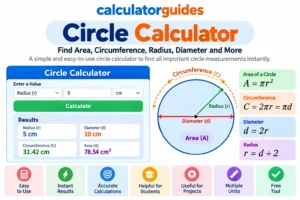
Circle Calculator
Use the calculator above to find the measurements of a circle.
You can normally enter any one of these values:
- Radius
- Diameter
- Circumference
- Area
The calculator can then calculate the remaining values.
For example, if you only know the diameter of a round table, you can find its radius, circumference, and area.
If you know the circumference of a circular object, you can work backward to find its radius and diameter.
For partial circles, you can also calculate values such as arc length and sector area when a central angle is known.
Circle Formula
The most important circle formulas are easy to remember.
Radius
The radius is the distance from the center of a circle to its edge.
r = radius
Diameter
The diameter goes all the way across the circle through its center.
d = 2r
So:
r = d ÷ 2
Circumference Formula
The circumference is the distance around the outside of a circle.
The formula is:
C = 2πr
You can also use:
C = πd
Where:
- C = circumference
- r = radius
- d = diameter
- π = pi, approximately 3.14159
Both formulas give the same result.
Example
Suppose a circle has a radius of 5 cm.
C = 2 × π × 5
C = 10π
C ≈ 31.42 cm
So the circumference is about 31.42 cm.
Area of a Circle Formula
The area tells you how much space is inside a circle.
The formula is:
A = πr²
This means you multiply the radius by itself and then multiply the result by pi.
Example
Suppose the radius is 5 cm.
A = π × 5²
A = π × 25
A = 25π
A ≈ 78.54 cm²
So the area of the circle is approximately 78.54 square centimeters.
Remember that area uses square units, such as:
- cm²
- m²
- ft²
- in²
How to Calculate the Area of a Circle From Diameter
Sometimes you are given the diameter instead of the radius.
First, divide the diameter by 2 to find the radius.
For example:
Diameter = 20 cm
Radius = 20 ÷ 2
Radius = 10 cm
Now use:
A = πr²
A = π × 10²
A = 100π
A ≈ 314.16 cm²
You can also use the direct formula:
A = πd² ÷ 4
This is useful when the diameter is already known.
How to Calculate Circumference From Diameter
If you know the diameter, you do not need to find the radius first.
Use:
C = πd
Example
Diameter = 12 cm
C = π × 12
C = 12π
C ≈ 37.70 cm
The circumference is approximately 37.70 cm.
How to Find Radius From Diameter
This is one of the easiest circle calculations.
Use:
r = d ÷ 2
Example
Diameter = 18 cm
Radius = 18 ÷ 2
Radius = 9 cm
The radius is always half of the diameter.
How to Find Diameter From Radius
Use:
d = 2r
Example
Radius = 8 cm
Diameter = 2 × 8
Diameter = 16 cm
How to Find Radius From Circumference
If you know the circumference but not the radius, rearrange the circumference formula.
Starting formula:
C = 2πr
Therefore:
r = C ÷ 2π
Example
Suppose:
C = 31.42 cm
r = 31.42 ÷ 2π
r ≈ 5 cm
So the radius is approximately 5 cm.
How to Find Radius From Area
If you know the area, you can find the radius using:
r = √(A ÷ π)
Example
Area = 78.54 cm²
r = √(78.54 ÷ π)
r ≈ 5 cm
So the radius is approximately 5 cm.
This reverse calculation is especially useful when you know the total area of a circular object but need to determine its radius.
How to Find Diameter From Area
First find the radius:
r = √(A ÷ π)
Then:
d = 2r
For example, if the area is 314.16 cm²:
r = √(314.16 ÷ π)
r ≈ 10 cm
Therefore:
d = 2 × 10
d ≈ 20 cm
How to Find Area From Circumference
If circumference is known, first calculate the radius:
r = C ÷ 2π
Then calculate area:
A = πr²
There is also a direct formula:
A = C² ÷ 4π
Example
Suppose circumference = 31.42 cm.
A = 31.42² ÷ 4π
A ≈ 78.54 cm²
What Is Pi (π)?
Pi is a special mathematical constant used in circle calculations.
Its approximate value is:
π ≈ 3.14159265
For many everyday calculations, 3.14 is enough.
Some school problems may ask you to use 22/7 instead.
The important thing is to follow the value of pi requested by the question.
If the calculator uses the full value of pi, the result may be slightly different from a calculation using 3.14 or 22/7.
Circle Radius vs Diameter
Radius and diameter are closely related, but they are not the same thing.
Radius
The radius is the distance from the center to the edge.
Diameter
The diameter is the distance from one side of the circle to the other side through the center.
The relationship is:
Diameter = 2 × Radius
and
Radius = Diameter ÷ 2
Example
If radius = 7 cm:
Diameter = 14 cm.
If diameter = 30 cm:
Radius = 15 cm.
What Is Circumference?
Circumference is the distance around the outside edge of a circle.
You can think of it as the circular version of perimeter.
For example, if you wrap a measuring tape around a round table, the distance measured around the edge is approximately its circumference.
Use:
C = 2πr
or:
C = πd
Circumference is measured in normal length units such as:
- millimeters
- centimeters
- meters
- inches
- feet
- yards
It is not measured in square units.
What Is the Area of a Circle?
The area of a circle is the amount of two-dimensional space inside its boundary.
Use:
A = πr²
For example, a circular garden with an area of 100 m² has 100 square meters of surface area.
Area is especially useful when calculating:
- Flooring
- Circular gardens
- Round pools
- Tables
- Paving
- Circular signs
- Circular fields
- Wheels
- Covers
- Plates
Arc Length Calculator
An arc is a part of the curved edge of a circle.
If you know the radius and the central angle, you can calculate the arc length.
For an angle measured in degrees:
Arc Length = (θ ÷ 360) × 2πr
Where:
- θ = central angle
- r = radius
This works because the angle represents a fraction of the full 360° circle.
Example
Radius = 10 cm
Angle = 90°
Arc length:
= (90 ÷ 360) × 2π × 10
= ¼ × 20π
≈ 15.71 cm
So the 90-degree arc is about 15.71 cm long.
Sector Area Calculator
A sector is like a slice of a circle.
For example, a pizza slice can look like a sector.
The formula for sector area is:
Sector Area = (θ ÷ 360) × πr²
Where:
- θ = central angle
- r = radius
Example
Radius = 10 cm
Angle = 90°
Sector area:
= (90 ÷ 360) × π × 10²
= ¼ × 100π
≈ 78.54 cm²
A 90° sector represents one-quarter of the full circle.
Common Circle Angles
Some angles represent simple fractions of a circle.
| Angle | Part of Circle |
|---|---|
| 30° | 1/12 |
| 45° | 1/8 |
| 60° | 1/6 |
| 90° | 1/4 |
| 120° | 1/3 |
| 180° | 1/2 |
| 270° | 3/4 |
| 360° | Full circle |
This makes sector and arc calculations easier.
For example, a 180° sector is exactly half of a circle.
Chord Length of a Circle
A chord is a straight line connecting two points on the circumference of a circle.
If you know the radius and central angle, the chord length can be calculated using:
Chord = 2r sin(θ/2)
This is different from an arc because a chord is straight while an arc follows the curved edge of the circle.
Chord calculations are useful in geometry, engineering, design, and circular measurements.
Circle Segment
A circle segment is the region between a chord and an arc.
It is different from a sector.
Sector
A sector is bounded by:
- Two radii
- One arc
Segment
A segment is bounded by:
- One chord
- One arc
For a minor segment, its area can be found by subtracting the triangle formed by the two radii and the chord from the sector area.
Circle Perimeter Calculator
The perimeter of a circle is normally called its circumference.
So when someone searches for:
- Circle perimeter calculator
- Perimeter of a circle
- Circular perimeter calculator
- Find perimeter of a circle
the calculation is:
C = 2πr
or:
C = πd
For a radius of 10 meters:
C = 2 × π × 10
C ≈ 62.83 meters
Circle Calculator Example
Let’s work through a complete example.
Suppose you have:
Radius = 7 cm
Step 1: Find diameter
d = 2r
d = 2 × 7
d = 14 cm
Step 2: Find circumference
C = 2πr
C = 2 × π × 7
C ≈ 43.98 cm
Step 3: Find area
A = πr²
A = π × 7²
A = 49π
A ≈ 153.94 cm²
So:
- Radius = 7 cm
- Diameter = 14 cm
- Circumference ≈ 43.98 cm
- Area ≈ 153.94 cm²
Circle Calculator Example With Diameter
Suppose the diameter is 20 inches.
First find the radius:
r = 20 ÷ 2
r = 10 inches
Now calculate circumference:
C = π × 20
C ≈ 62.83 inches
Now calculate area:
A = π × 10²
A ≈ 314.16 square inches
Final result:
- Diameter = 20 in
- Radius = 10 in
- Circumference ≈ 62.83 in
- Area ≈ 314.16 in²
Circle Measurement Table
Here are some common values using the radius as the starting measurement.
| Radius | Diameter | Circumference | Area |
|---|---|---|---|
| 1 | 2 | 6.28 | 3.14 |
| 2 | 4 | 12.57 | 12.57 |
| 5 | 10 | 31.42 | 78.54 |
| 10 | 20 | 62.83 | 314.16 |
| 15 | 30 | 94.25 | 706.86 |
| 20 | 40 | 125.66 | 1,256.64 |
| 25 | 50 | 157.08 | 1,963.50 |
| 50 | 100 | 314.16 | 7,853.98 |
The values above use π at approximately 3.14159.
Circle Calculator Units
You can calculate circles using many different units.
Common length units include:
- Millimeters (mm)
- Centimeters (cm)
- Meters (m)
- Kilometers (km)
- Inches (in)
- Feet (ft)
- Yards (yd)
- Miles (mi)
Remember that the unit changes depending on what you calculate.
Length measurements
Radius, diameter, circumference, and arc length use units such as:
cm, m, in, ft
Area measurements
Area and sector area use square units:
cm², m², in², ft²
For example:
10 meters is a length.
100 square meters is an area.
Do not confuse the two.
Why Use an Online Circle Calculator?
Doing circle calculations by hand is not difficult, but an online calculator can save time and reduce simple mistakes.
A good circle calculator can:
- Calculate area quickly
- Find circumference
- Convert radius to diameter
- Find radius from diameter
- Find radius from area
- Find radius from circumference
- Calculate arc length
- Calculate sector area
- Show multiple results together
- Reduce calculator mistakes
- Help check homework
- Help with practical measurements
It is especially useful when you need several circle measurements at the same time.
Where Are Circle Calculations Used?
Circle formulas are used in many real-world situations.
Construction
Builders may need circular measurements for:
- Round foundations
- Circular patios
- Pools
- Paving
- Circular walls
- Pipes
Home Projects
You can use circle calculations for:
- Round tables
- Rugs
- Garden beds
- Circular decorations
- Covers
- Pool areas
Engineering
Engineers work with circular parts such as:
- Wheels
- Gears
- Pipes
- Bearings
- Rotating parts
- Mechanical components
Education
Students use circle formulas in:
- Geometry
- Algebra
- Mensuration
- Trigonometry
- School exams
- Entrance tests
Design
Designers may need circular measurements for:
- Logos
- Signs
- Product shapes
- Patterns
- Layouts
- Technical drawings
Common Circle Calculation Mistakes
Circle calculations are simple, but a few mistakes happen often.
1. Confusing radius and diameter
The radius is half the diameter.
Do not use the diameter as the radius unless you have first divided it by 2.
2. Forgetting to square the radius
Area is:
A = πr²
It is not:
A = πr
The radius must be squared.
3. Using the wrong formula
Circumference and area are different.
Circumference:
C = 2πr
Area:
A = πr²
4. Mixing units
Do not use a radius in centimeters and a diameter in meters without converting them first.
Keep your units consistent.
5. Confusing circumference and area
Circumference is a length.
Area measures a surface.
For example:
- Circumference = cm
- Area = cm²
6. Rounding too early
If you are doing several calculations, keep more decimal places until the final answer.
This can help avoid small rounding errors.
Circle Calculator for Students
Students often use circle calculators for homework, practice, and checking answers.
The most important formulas to remember are:
Diameter = 2r
Radius = d ÷ 2
Circumference = 2πr
Circumference = πd
Area = πr²
Arc Length = (θ ÷ 360) × 2πr
Sector Area = (θ ÷ 360) × πr²
Once you understand these formulas, most basic circle problems become much easier.
Circle Calculator vs Circumference Calculator
A circumference calculator is focused mainly on the distance around a circle.
A Circle Calculator can provide several measurements at the same time.
For example, a complete circle calculator may calculate:
- Radius
- Diameter
- Circumference
- Area
- Arc length
- Sector area
So a circle calculator can be useful when you need more than just the circumference.
Circle Area Calculator
A Circle Area Calculator is used to find the amount of space inside a circle.
The main formula is:
A = πr²
If the diameter is known:
A = πd² ÷ 4
Quick example
Diameter = 10 cm
Radius = 5 cm
Area:
A = π × 5²
A = 25π
A ≈ 78.54 cm²
Circumference From Area
You can also calculate circumference when the area is known.
First find radius:
r = √(A ÷ π)
Then:
C = 2πr
For example, if the area is approximately 78.54 cm²:
r ≈ 5 cm
Then:
C ≈ 31.42 cm
Diameter From Circumference
If you know the circumference, you can directly calculate diameter.
Use:
d = C ÷ π
Example
C = 62.83 cm
d = 62.83 ÷ π
d ≈ 20 cm
So the diameter is approximately 20 cm.
Radius From Circumference
Use:
r = C ÷ 2π
For example:
C = 62.83 cm
r = 62.83 ÷ 2π
r ≈ 10 cm
Circle Calculator With 3.14
If a question tells you to use π = 3.14, use 3.14 instead of the full value.
For example:
Radius = 10 cm
Area:
A = 3.14 × 10²
A = 3.14 × 100
A = 314 cm²
If you use the full value of pi, you get approximately 314.16 cm².
Both can be correct depending on the instructions and required rounding.
Circle Calculator With 22/7
Some school questions use:
π = 22/7
For example:
Radius = 7 cm
Area:
A = 22/7 × 7²
A = 22/7 × 49
A = 154 cm²
This is a convenient value when the radius is a multiple of 7.
Always use the value of pi specified by your question.
Frequently Asked Questions About Circle Calculator
What is a Circle Calculator?
A Circle Calculator is an online tool that calculates measurements such as radius, diameter, circumference, and area from a known circle measurement.
What is the formula for the area of a circle?
The formula is:
A = πr²
where r is the radius.
What is the formula for circumference?
The formula is:
C = 2πr
You can also use:
C = πd
where d is the diameter.
How do I find the radius from the diameter?
Divide the diameter by 2.
r = d ÷ 2
How do I find the diameter from the radius?
Multiply the radius by 2.
d = 2r
How do I find the radius from circumference?
Use:
r = C ÷ 2π
How do I find radius from area?
Use:
r = √(A ÷ π)
How do I find diameter from circumference?
Use:
d = C ÷ π
What is pi in a circle calculation?
Pi, written as π, is approximately 3.14159265.
Is circumference the same as perimeter?
For a circle, the distance around the circle is called its circumference. It is the circular equivalent of perimeter.
What is the difference between radius and diameter?
The radius goes from the center to the edge. The diameter goes from one side to the other through the center.
The diameter is twice the radius.
What is an arc?
An arc is a curved part of the circumference of a circle.
What is arc length?
Arc length is the distance along an arc.
For an angle in degrees:
L = (θ ÷ 360) × 2πr
What is a sector?
A sector is a slice of a circle formed by two radii and an arc.
How do I calculate sector area?
Use:
Sector Area = (θ ÷ 360) × πr²
What is a chord?
A chord is a straight line connecting two points on the circumference of a circle.
Can I calculate a circle if I only know its area?
Yes. You can find the radius using:
r = √(A ÷ π)
Then use the radius to calculate the diameter and circumference.
Can I calculate a circle if I only know its circumference?
Yes. Find the radius using:
r = C ÷ 2π
Then calculate the other measurements.
What units can I use?
You can use units such as centimeters, meters, millimeters, inches, feet, yards, and other length units.
For area, remember to use square units.
What happens if I double the radius?
If the radius doubles, the diameter and circumference also double.
But the area becomes four times larger because the radius is squared in the area formula.
For example:
Radius = 5 → Area ≈ 78.54
Radius = 10 → Area ≈ 314.16
The radius doubled, but the area became four times as large.
Circle Calculator: Quick Reference
If you know the radius:
- Diameter = 2r
- Circumference = 2πr
- Area = πr²
If you know the diameter:
- Radius = d/2
- Circumference = πd
- Area = πd²/4
If you know the circumference:
- Radius = C/(2π)
- Diameter = C/π
- Area = C²/(4π)
If you know the area:
- Radius = √(A/π)
- Diameter = 2√(A/π)
- Circumference = 2π√(A/π)
For an arc:
- Arc length = (θ/360) × 2πr
For a sector:
- Sector area = (θ/360) × πr²
Final Thoughts
A Circle Calculator makes it much easier to work with circles when you do not want to calculate every measurement manually.
The most important things to remember are simple:
Radius = half of diameter
Diameter = twice the radius
Circumference = 2πr
Area = πr²
If you are working with only part of a circle, the central angle becomes important. You can use it to calculate arc length and sector area by finding what fraction of the full 360° circle is involved.
You can use our Circle Calculator whenever you need a quick answer for circle area, circumference, radius, diameter, arc length, sector area, or other common circle measurements. It is useful for school mathematics, homework, construction, engineering, design, DIY projects, and everyday measurements.
The goal is simple: enter the value you already know, let the calculator handle the formula, and use the result you need.