
Position Size Calculator-Use our free Position Size Calculator to calculate position size based on account balance, risk percentage, entry price and stop-loss price. Simple trading risk calculator with formulas and examples.Find the right calculator for quick conversions Stock Lending Calculator Lending, ETF Return Calculator and everyday calculations at CalculatorGuides.
Calculate your optimal share quantity and risk parameters per trade. Calculator Guides - Position Size
Position Size Calculator
A Position Size Calculator helps traders determine how large a trade should be based on the amount they are willing to risk.
Instead of choosing a position size randomly, you can calculate it using:
- Account balance
- Risk percentage
- Entry price
- Stop-loss price
- Risk per share or unit
- Position value
- Number of shares or units
This can help traders keep the potential loss of an individual trade within a predefined risk limit.
Important: A position size calculation does not guarantee a profit or prevent losses. Actual losses can be different because of slippage, gaps, brokerage, taxes, liquidity, and execution prices.
What Is Position Size?
Position size is the amount of an asset you buy or sell in a trade.
For stocks, position size is commonly expressed as the number of shares.
For example:
- 100 shares of a stock = position size of 100 shares
- Entry price = ₹500
- Position value = ₹50,000
Position size is different from account size.
Your account may be worth ₹5,00,000, while the actual position may be ₹50,000.
What Is a Position Size Calculator?
A Position Size Calculator works backward from your maximum acceptable risk.
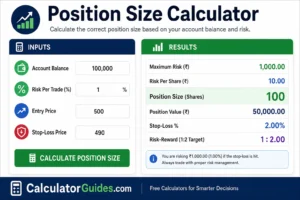
For example, suppose:
Account balance = ₹1,00,000
Risk per trade = 1%
Maximum risk = ₹1,000
Entry price = ₹500
Stop-loss price = ₹490
Risk per share:
₹500 − ₹490 = ₹10
Position size:
₹1,000 ÷ ₹10 = 100 shares
So the calculated position is 100 shares.
Position Size Formula
The basic formula is:
Position Size = Maximum Risk ÷ Risk Per Share
First calculate maximum risk:
Maximum Risk = Account Balance × Risk Percentage ÷ 100
Then calculate risk per share:
Risk Per Share = Entry Price − Stop-Loss Price
For a long trade:
Position Size = Account Risk ÷ (Entry Price − Stop-Loss Price)
Position Size Example
Suppose:
Account balance:
₹2,00,000
Risk per trade:
1%
Entry price:
₹1,000
Stop-loss:
₹950
Step 1: Calculate Maximum Risk
₹2,00,000 × 1%
= ₹2,000
Step 2: Calculate Risk Per Share
₹1,000 − ₹950
= ₹50
Step 3: Calculate Position Size
₹2,000 ÷ ₹50
= 40 shares
So the theoretical position size is:
40 shares
Position Value
Position value is different from risk.
Formula:
Position Value = Position Size × Entry Price
Using the previous example:
40 shares × ₹1,000
= ₹40,000
Your position value is ₹40,000, while your planned risk is ₹2,000.
That means a 5% move from the entry price to the stop-loss represents the planned ₹2,000 risk before costs and execution differences.
Risk Per Trade
Risk per trade is the maximum amount you are willing to lose if your stop-loss is reached.
For example:
Account:
₹5,00,000
Risk:
1%
Maximum planned risk:
₹5,000
This does not mean the trade cannot lose more than ₹5,000. A gap, slippage, or other execution issue can result in a larger loss.
Risk Percentage Formula
Risk % = Maximum Risk ÷ Account Balance × 100
Example:
Account balance:
₹1,00,000
Maximum risk:
₹1,000
Risk percentage:
₹1,000 ÷ ₹1,00,000 × 100 = 1%
Stop-Loss Distance
Stop-loss distance tells you how much the price can move against your position before your stop is reached.
For a long position:
Stop Distance = Entry Price − Stop-Loss Price
Example:
Entry:
₹800
Stop-loss:
₹760
Distance:
₹40
If you risk ₹2,000:
Position size:
₹2,000 ÷ ₹40 = 50 shares
Stop-Loss Percentage
You can also express the stop distance as a percentage.
Formula:
Stop-Loss % = (Entry Price − Stop Price) ÷ Entry Price × 100
Example:
Entry:
₹500
Stop:
₹475
Difference:
₹25
Stop-loss percentage:
₹25 ÷ ₹500 × 100 = 5%
Position Size Using Risk Percentage
Suppose:
Account balance:
₹1,00,000
Risk:
2%
Entry:
₹500
Stop-loss:
₹480
Maximum risk:
₹1,000 × 2 = ₹2,000
Risk per share:
₹20
Position size:
₹2,000 ÷ ₹20 = 100 shares
Position value:
100 × ₹500 = ₹50,000
Position Size for a Short Trade
For a short position, the risk calculation is reversed.
Formula:
Risk Per Share = Stop-Loss Price − Entry Price
Example:
Entry:
₹500
Stop-loss:
₹520
Risk per share:
₹20
If maximum risk is:
₹2,000
Position size:
₹2,000 ÷ ₹20 = 100 shares
The same risk-management principle applies, but the price direction is reversed.
Position Size for Futures
Futures require an additional consideration:
Contract or lot size
The risk is not simply the difference between entry and stop price.
Formula:
Trade Risk = Price Risk × Lot Size × Number of Lots
Example:
Entry:
₹2,000
Stop:
₹1,980
Price risk:
₹20
Lot size:
50
Risk per lot:
₹20 × 50
= ₹1,000
If your maximum risk is ₹5,000:
₹5,000 ÷ ₹1,000 = 5 lots
This is a simplified example. Actual futures trading involves contract specifications, margin, brokerage, taxes, and execution considerations.
Position Size for Options
Options require extra care because the option premium can change rapidly and may not move one-for-one with the underlying asset.
A simple position-size calculation based only on the underlying price is not enough for every options strategy.
For an options trade, consider:
- Premium paid
- Stop-loss
- Contract size
- Maximum loss
- Implied volatility
- Time decay
- Liquidity
- Bid-ask spread
For option buying, the premium paid can be an important part of the maximum theoretical loss if the option expires worthless.
Position Size and Leverage
Leverage allows you to control a larger position with less capital.
However:
Leverage does not reduce the underlying market risk.
A larger position can create larger gains and larger losses.
Position sizing should therefore be based on the amount you are prepared to lose, rather than simply on the maximum leverage available.
Position Size vs Margin
These are different concepts.
Position Size
The size of your actual market exposure.
Margin
The amount of capital required by the broker or exchange to open and maintain a position.
A trade can have a relatively small margin requirement but a much larger market exposure.
Do not confuse margin available with the amount you can safely risk.
Position Size and Risk-Reward Ratio
Position size and risk-reward ratio work together.
Suppose:
Entry:
₹500
Stop-loss:
₹480
Target:
₹540
Risk:
₹20 per share
Potential reward:
₹40 per share
Risk-reward ratio:
1:2
If your calculated position size is 100 shares:
Potential loss:
100 × ₹20 = ₹2,000
Potential gross profit at target:
100 × ₹40 = ₹4,000
This is a hypothetical calculation and does not account for costs or execution differences.
Position Size and Stop-Loss
A wider stop-loss generally means a smaller position if your maximum risk remains unchanged.
Example:
Account risk:
₹2,000
Stop distance ₹10
Position:
200 shares
Stop distance ₹20
Position:
100 shares
Stop distance ₹40
Position:
50 shares
This allows the planned monetary risk to remain approximately the same.
Why Position Sizing Matters
A trader can have a good strategy and still experience large losses if individual positions are too large.
Position sizing can help:
- Limit risk per trade
- Reduce emotional pressure
- Protect trading capital
- Avoid oversized positions
- Maintain consistency
- Survive losing streaks
No position-sizing method can eliminate trading risk.
Position Size Example for ₹1 Lakh Account
Suppose:
Account:
₹1,00,000
Risk:
1%
Maximum risk:
₹1,000
Entry:
₹250
Stop:
₹240
Risk per share:
₹10
Position size:
₹1,000 ÷ ₹10 = 100 shares
Position value:
₹25,000
So the calculated trade has ₹25,000 of market value and approximately ₹1,000 of planned stop-loss risk.
Position Size Example for ₹5 Lakh Account
Account:
₹5,00,000
Risk:
1%
Maximum risk:
₹5,000
Entry:
₹1,000
Stop:
₹950
Risk per share:
₹50
Position size:
₹5,000 ÷ ₹50 = 100 shares
Position value:
₹1,00,000
Position Size Example for ₹10 Lakh Account
Account:
₹10,00,000
Risk:
1%
Maximum risk:
₹10,000
Entry:
₹2,000
Stop:
₹1,950
Risk per share:
₹50
Position size:
₹10,000 ÷ ₹50 = 200 shares
Position value:
₹4,00,000
Position Size With Brokerage and Charges
A basic calculator usually calculates risk before transaction costs.
However, your actual trading loss can include:
- Brokerage
- Exchange charges
- GST
- Securities transaction tax where applicable
- Stamp duty
- Slippage
- Other applicable costs
If your risk limit is strict, consider these costs when deciding the final position size.
Position Size and Slippage
Slippage occurs when your actual execution price differs from the price you expected.
For example:
Expected stop:
₹490
Actual exit:
₹485
The actual loss will be larger than the calculation based on ₹490.
This is particularly important in:
- Fast markets
- Low-liquidity stocks
- Gap-down openings
- Highly volatile securities
Position Size for Gap Risk
A stop-loss does not always guarantee an exact exit price.
If a stock opens below your stop price, your order may execute at a lower price.
For this reason, calculated risk should be treated as planned risk, not guaranteed maximum loss.
Position Size and Portfolio Risk
Risk should not be considered only trade by trade.
Suppose you have five positions, each with planned risk of:
1%
Your total portfolio risk could become significant if several positions move against you at the same time.
This is especially important when multiple positions are highly correlated.
Correlation and Position Size
Two different stocks may appear to be separate trades but can move together.
For example, several stocks in the same sector can respond to the same:
- Economic news
- Industry news
- Interest-rate changes
- Commodity prices
- Market sentiment
Therefore, portfolio-level exposure matters in addition to individual trade risk.
Position Size Calculator Formula Summary
Maximum Risk
Maximum Risk = Account Balance × Risk % ÷ 100
Long Trade Risk Per Share
Risk Per Share = Entry Price − Stop Price
Short Trade Risk Per Share
Risk Per Share = Stop Price − Entry Price
Position Size
Position Size = Maximum Risk ÷ Risk Per Share
Position Value
Position Value = Position Size × Entry Price
Stop-Loss Percentage
Stop % = Risk Per Share ÷ Entry Price × 100
Risk-Reward Ratio
Risk-Reward = Potential Reward ÷ Potential Risk
How to Use the Position Size Calculator
Step 1: Enter Account Balance
Enter the amount of trading capital you are using.
Step 2: Enter Risk Percentage
Enter the percentage of your account you are willing to risk.
Step 3: Enter Entry Price
Enter your planned trade entry.
Step 4: Enter Stop-Loss Price
Enter the price where you plan to exit if the trade moves against you.
Step 5: Calculate
The calculator can show:
- Maximum risk
- Risk per share
- Position size
- Position value
- Stop-loss percentage
- Potential reward if a target is entered
Step 6: Round Down
If the result is a fractional number of shares, round down to a whole tradable quantity where appropriate.
Common Position Size Calculation Mistakes
Using the Whole Account as Risk
Your position value is not the same as your maximum acceptable loss.
Ignoring the Stop-Loss
Without a planned exit level, risk per share cannot be calculated in the same way.
Confusing Margin With Risk
The margin requirement does not represent your maximum possible trading loss.
Ignoring Slippage
Actual execution may differ from your calculated stop.
Using Too Much Leverage
Leverage can magnify losses as well as gains.
Forgetting Contract Size
Futures and options generally require contract or lot-size calculations.
Assuming the Calculated Risk Is Guaranteed
Gaps and fast markets can cause larger losses.
Frequently Asked Questions
What is a Position Size Calculator?
A Position Size Calculator determines how many shares or units you can trade based on your account size, risk percentage, entry price, and stop-loss.
How do I calculate position size?
Use:
Position Size = Maximum Risk ÷ Risk Per Share
What is maximum risk?
Maximum risk is the amount you plan to lose if the trade reaches your stop-loss.
What is risk per share?
For a long trade:
Entry Price − Stop Price
For a short trade:
Stop Price − Entry Price
What is a good risk percentage per trade?
There is no universal percentage that is appropriate for everyone. The right amount depends on your strategy, risk tolerance, capital, and overall portfolio exposure.
Can I use the calculator for stocks?
Yes. It is particularly straightforward for stock positions.
Can I use it for futures?
Yes, but you must include the contract or lot size.
Can I use it for options?
Yes, but options require additional considerations such as premium, contract size, volatility, and strategy-specific risk.
Does position size include leverage?
The calculator can determine position size independently of leverage. Leverage may affect the margin required, but it does not remove market risk.
What happens if my stop-loss is wider?
If your maximum risk stays the same, a wider stop generally results in a smaller position size.
What happens if my stop-loss is closer?
A closer stop generally allows a larger position for the same planned monetary risk, although a stop that is too close may be triggered by normal market movement.
Does position sizing guarantee that I will only lose my calculated amount?
No. Gaps, slippage, liquidity problems, and execution issues can result in a larger loss.
What is position value?
Position value is:
Number of Shares × Entry Price
It represents the approximate market value of the position at entry.
What is the difference between position size and account size?
Account size is your available trading capital. Position size is the amount of a particular security you are trading.
Can position sizing reduce trading risk?
It can help control planned risk per trade, but it cannot eliminate market risk.
Is the Position Size Calculator accurate?
The mathematical calculation is accurate for the inputs entered. Actual trading results can differ because of execution, slippage, gaps, fees, and market conditions.
Is the Position Size Calculator free?
Yes. The CalculatorGuides.com Position Size Calculator is free to use.
Position Size Calculator – Important Things to Remember
Before entering a trade, consider:
- Account balance
- Maximum acceptable risk
- Entry price
- Stop-loss
- Position size
- Position value
- Brokerage and taxes
- Slippage
- Liquidity
- Portfolio-level exposure
- Correlation with existing positions
A calculator can help with the mathematics, but it cannot determine whether a trade itself is a good investment.
Conclusion
A Position Size Calculator helps traders decide how many shares or units to trade based on a predefined risk amount.
The core formula is:
Position Size = Maximum Risk ÷ Risk Per Share
For example, with a ₹1,00,000 account, a 1% risk limit gives a planned maximum risk of ₹1,000. If the difference between the entry price and stop-loss is ₹10 per share, the calculated position size is 100 shares.
Position sizing is useful because it connects your account size, risk percentage, entry price, and stop-loss into one calculation.
However, calculated risk is not a guaranteed maximum loss. Slippage, price gaps, liquidity, brokerage, taxes, and fast market movements can cause the actual loss to be higher.
Use the CalculatorGuides.com Position Size Calculator to calculate your planned trade size and risk before placing a trade, and always consider your total portfolio exposure rather than looking at one position in isolation.