
Yearly SIP Calculator-Use our free Yearly SIP Calculator to calculate annual SIP investment, total invested amount, estimated returns, maturity value, and wealth growth over time.Explore our complete collection of Stock Lending Calculator Lending, ETF Return Calculator ,Position Size Calculator, Short Term Capital Gain Tax Calculator,Gold Loan Calculator,conversion and everyday calculators at CalculatorGuides to find the right tool for your needs.
Compound your wealth with yearly SIP investments in Mutual Funds. Calculator Guides - Yearly SIP
Yearly SIP Calculator
A Yearly SIP Calculator helps you estimate how much your investment could grow when you invest a fixed amount every year through a Systematic Investment Plan (SIP).
Most SIP calculators focus on monthly investments, but some investors prefer making one investment every year. A yearly SIP calculator is useful for planning long-term investments based on an annual contribution.
You can use it to estimate:
- Yearly investment amount
- Total amount invested
- Estimated returns
- Final maturity value
- Wealth gained
- Investment period
- Expected annual return
- Growth through compounding
For example, if you invest ₹1,00,000 every year for 15 years and assume an annual return of 10%, the calculator can estimate the potential value of your investment at the end of the period.
Important: SIP returns are not guaranteed. The final value depends on actual market performance, investment timing, fees, taxes, and the type of investment.
What Is a Yearly SIP?
A yearly SIP is a systematic investment approach where you invest a fixed amount at a regular yearly interval.
For example:
₹50,000 every year
for:
10 years
Total contributions:
₹5,00,000
If the investments earn returns over time, the portfolio can potentially grow beyond the amount you contributed.
The exact result depends on when each yearly investment is made and how the investment performs afterward.
What Is a Yearly SIP Calculator?
A Yearly SIP Calculator is an online financial planning tool that estimates the future value of regular annual investments.
It generally requires:
- Annual investment amount
- Expected annual return
- Investment period
The calculator can then estimate:
Total Investment + Estimated Returns = Estimated Future Value
How Does a Yearly SIP Calculator Work?
Suppose you invest:
₹1,00,000 per year
for:
10 years
and assume:
12% annual return
You will contribute:
₹10,00,000
The calculator then estimates how the contributions may grow through compounding.
The first investment has more time to grow than the last investment.
This is why the final value is not simply:
Annual Investment × Years
Yearly SIP Formula
For an annual investment made at the end of each year, the future value of a regular annual investment can be calculated using:
FV = P × [((1 + r)^n − 1) ÷ r]
Where:
- FV = future value
- P = annual investment
- r = annual expected return in decimal form
- n = number of years
For example, if the expected return is 10%:
r = 10 ÷ 100 = 0.10
This formula assumes the investment is made at the end of each year.
Yearly SIP Example
Suppose:
Annual SIP:
₹1,00,000
Expected return:
10%
Investment period:
10 years
Using the annual SIP formula:
FV = ₹1,00,000 × [((1.10)^10 − 1) ÷ 0.10]
Estimated future value:
₹15,93,742 approximately
Total investment:
₹10,00,000
Estimated gain:
₹5,93,742
This is a mathematical illustration, not a guaranteed investment return.
Yearly SIP Investment Breakdown
Using the above example:
| Detail | Amount |
|---|---|
| Annual Investment | ₹1,00,000 |
| Investment Period | 10 years |
| Total Investment | ₹10,00,000 |
| Assumed Return | 10% |
| Estimated Value | ₹15,93,742 |
| Estimated Gain | ₹5,93,742 |
The actual value can be higher or lower because investment returns fluctuate.
Yearly SIP With 12% Return
Suppose you invest:
₹1,00,000 every year
for:
15 years
at an assumed:
12% annual return
Total amount invested:
₹15,00,000
The calculator can estimate the potential future value using annual compounding.
The result should be treated as a projection rather than a promise of future performance.
Yearly SIP for 5 Years
Suppose:
Annual investment:
₹50,000
Period:
5 years
Total contributions:
₹2,50,000
If you assume a 10% annual return, the estimated future value is approximately:
₹3,05,255
Estimated gain:
₹55,255
Yearly SIP for 10 Years
Suppose:
Annual investment:
₹1,00,000
Period:
10 years
Total investment:
₹10,00,000
At an assumed 10% return:
Estimated value:
₹15,93,742
Estimated gain:
₹5,93,742
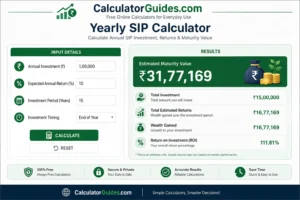
Yearly SIP for 15 Years
Suppose:
Annual investment:
₹1,00,000
Period:
15 years
Total investment:
₹15,00,000
At an assumed 10% annual return, the estimated value is approximately:
₹31,77,169
Estimated gain:
₹16,77,169
This example shows how the length of the investment period can significantly affect the potential effect of compounding.
Yearly SIP for 20 Years
Suppose:
Annual investment:
₹1,00,000
Investment period:
20 years
Expected return:
10%
Total contribution:
₹20,00,000
Estimated future value:
₹57,27,500 approximately
Estimated gain:
₹37,27,500
The large difference between contributions and estimated value illustrates the mathematical effect of long-term compounding.
Yearly SIP vs Monthly SIP
Both approaches involve regular investing, but the timing is different.
| Feature | Yearly SIP | Monthly SIP |
|---|---|---|
| Investment frequency | Once per year | Once per month |
| Planning | Annual | Monthly |
| Cash requirement | Larger at one time | Smaller recurring amount |
| Compounding timing | Depends on investment date | More frequent contributions |
| Suitable for | Annual surplus or yearly income | Regular monthly income |
A monthly SIP and yearly SIP should not be expected to produce exactly the same result even when the annual contribution is identical because the investment timing differs.
Yearly SIP vs Lump Sum
A yearly SIP involves multiple investments over time.
A lump-sum investment puts the entire amount into the investment at once.
For example:
Yearly SIP
₹1,00,000 every year for 10 years.
Lump Sum
₹10,00,000 invested at the beginning.
Even though both involve ₹10 lakh of total contributions, the investment has more time to compound in the lump-sum example because the full amount is invested earlier.
Yearly SIP and Compounding
Compounding means your investment growth can itself generate additional growth.
For example:
You invest:
₹1,00,000
At 10%:
Year 1 growth:
₹10,000
The following year’s growth can be calculated on the larger balance, assuming the return is achieved.
With regular yearly investments, each contribution has a different amount of time to compound.
Step-Up Yearly SIP
Some investors increase their SIP amount every year.
For example:
Year 1:
₹1,00,000
Year 2:
₹1,10,000
Year 3:
₹1,21,000
This would represent a 10% annual increase.
A Step-Up SIP Calculator can be used when the annual investment changes each year.
This approach may be useful when income is expected to increase over time.
Yearly SIP With Step-Up
Suppose:
Starting yearly investment:
₹1,00,000
Annual increase:
10%
Investment period:
10 years
The annual contribution would increase over time rather than remaining fixed.
This can result in a substantially higher total investment and potentially a higher final value than a fixed yearly SIP.
However, it also requires increasing your yearly contribution.
Yearly SIP and Inflation
Inflation reduces the purchasing power of money over time.
For example, ₹10 lakh today will generally buy more goods and services than ₹10 lakh many years from now if prices rise.
Therefore, when planning a long-term SIP, consider both:
Nominal return
and
Inflation-adjusted return
A high future value does not automatically mean the same level of purchasing power.
Real Return After Inflation
A simplified real-return formula is:
Real Return = [(1 + Investment Return) ÷ (1 + Inflation Rate)] − 1
For example:
Investment return:
10%
Inflation:
6%
Real return:
(1.10 ÷ 1.06) − 1
≈ 3.77%
This is a simplified calculation and does not account for taxes or other investment costs.
Yearly SIP for Retirement
A yearly SIP can be used as part of long-term retirement planning.
For example, you may invest a fixed amount every year toward a retirement goal.
However, retirement planning requires more than simply estimating the final investment value.
You should also consider:
- Current age
- Retirement age
- Inflation
- Expected expenses
- Existing investments
- Emergency savings
- Tax
- Investment risk
- Expected retirement duration
Yearly SIP for a Financial Goal
The same calculator can help with long-term goals such as:
- Retirement
- Children’s education
- House purchase
- Wealth creation
- Travel
- Large future expenses
Start with your target amount and work backward to estimate how much you may need to invest each year.
How Much Should I Invest Every Year?
There is no single correct yearly SIP amount.
It depends on:
- Income
- Expenses
- Existing savings
- Financial goals
- Investment period
- Risk tolerance
- Emergency fund
- Debt obligations
A useful approach is to choose an amount that you can continue investing consistently without putting essential expenses at risk.
Yearly SIP Goal Calculator
Suppose your goal is:
₹50 lakh
in:
15 years
You can use a yearly SIP calculator to test different annual contribution amounts and assumed return rates.
For example, you could compare:
- ₹1 lakh per year
- ₹1.5 lakh per year
- ₹2 lakh per year
- ₹2.5 lakh per year
This helps you understand how changing the annual contribution affects the estimated future value.
Yearly SIP Calculator for ₹5,000
A yearly investment of ₹5,000 is relatively small, but the calculator can still estimate its long-term growth.
For example:
Annual investment:
₹5,000
Period:
20 years
Total contribution:
₹1,00,000
At an assumed annual return of 10%, the estimated value would be approximately:
₹2,86,375
The example demonstrates the effect of long-term compounding, but actual investment returns can vary.
Yearly SIP Calculator for ₹50,000
Annual investment:
₹50,000
Period:
20 years
Total contribution:
₹10,00,000
At an assumed 10% annual return:
Estimated value:
₹28,63,750 approximately
Estimated gain:
₹18,63,750
Yearly SIP Calculator for ₹1 Lakh
Annual investment:
₹1,00,000
Period:
20 years
At 10%:
Estimated value:
₹57,27,500 approximately
Total investment:
₹20,00,000
Estimated gain:
₹37,27,500
Yearly SIP Calculator for ₹2 Lakh
Annual investment:
₹2,00,000
Period:
20 years
At an assumed 10% return:
Estimated value:
₹1,14,55,000 approximately
Total investment:
₹40,00,000
Estimated gain:
₹74,55,000
Yearly SIP Calculator With Different Return Rates
Suppose you invest:
₹1,00,000 per year for 15 years.
Your estimated value changes significantly depending on the assumed return.
| Annual Return | Approx. Future Value |
|---|---|
| 6% | ₹23.28 lakh |
| 8% | ₹27.15 lakh |
| 10% | ₹31.77 lakh |
| 12% | ₹37.25 lakh |
| 15% | ₹44.34 lakh |
These figures are mathematical projections and should not be interpreted as expected or guaranteed market returns.
Why Return Assumptions Matter
A small change in the assumed annual return can produce a large difference over long periods.
This happens because the return compounds over time.
However, it is important not to choose an unrealistically high return simply because it produces a more attractive final number.
Use reasonable assumptions and compare multiple scenarios.
Yearly SIP Calculator Formula Summary
Total Investment
Total Investment = Annual Investment × Number of Years
Future Value
For end-of-year contributions:
FV = P × [((1 + r)^n − 1) ÷ r]
Estimated Gain
Gain = Future Value − Total Investment
Real Return
Real Return = [(1 + Return) ÷ (1 + Inflation)] − 1
The future-value formula assumes a constant return and regular contributions, which may not reflect actual market performance.
How to Use the Yearly SIP Calculator
Step 1: Enter Annual Investment
Enter the amount you plan to invest every year.
Step 2: Enter Expected Return
Enter an assumed annual rate of return.
Step 3: Enter Investment Period
Enter the number of years you plan to invest.
Step 4: Calculate
The calculator can show:
- Total investment
- Estimated returns
- Estimated maturity value
- Wealth gained
Step 5: Compare Scenarios
Try different investment amounts and return assumptions to understand how your results change.
Common Yearly SIP Calculation Mistakes
Treating Estimated Returns as Guaranteed
Market investments do not provide guaranteed returns unless the specific product explicitly offers a guarantee.
Ignoring Inflation
A future amount will have lower purchasing power if prices rise.
Comparing Yearly and Monthly SIP Directly
Investment timing differs, so the results may not be identical.
Using Unrealistically High Returns
A higher assumed return can make the final value look attractive but may create unrealistic expectations.
Forgetting Taxes and Costs
Actual wealth can be lower after applicable taxes, fund expenses, and transaction costs.
Investing More Than You Can Afford
A SIP should fit your overall financial plan.
Frequently Asked Questions
What is a Yearly SIP Calculator?
It is a tool that estimates the future value of regular annual investments using an assumed return and investment period.
How does a yearly SIP work?
You invest a fixed amount at regular yearly intervals, allowing each contribution to potentially grow over time.
What is the formula for yearly SIP?
For end-of-year contributions:
FV = P × [((1 + r)^n − 1) ÷ r]
Is yearly SIP better than monthly SIP?
Neither is automatically better. The appropriate option depends on your cash flow, investment schedule, and financial goals.
Can I invest once a year instead of every month?
Yes, depending on the investment product and your chosen investment strategy.
Can I increase my SIP every year?
Yes. Increasing the contribution annually is commonly called a step-up SIP.
What is a step-up SIP?
A step-up SIP increases the investment amount periodically, often every year.
Does SIP guarantee returns?
No. SIP is an investment method, not a guarantee of returns.
Can I use this calculator for mutual funds?
Yes, the mathematical projection can be used for regular investments in mutual funds when an assumed annual return is provided.
Can I use it for ETFs?
Yes, you can use the calculation for regular ETF investments, although actual ETF returns will fluctuate with the market.
Does the calculator account for inflation?
A basic calculator may show nominal future value. You can separately calculate the inflation-adjusted value to understand future purchasing power.
What happens if the investment return is 0%?
Your final value would simply equal the total amount contributed, assuming no fees, taxes, or other deductions.
Can yearly SIP make me a millionaire?
A regular investment can help build wealth over time, but there is no guaranteed outcome. The final amount depends on contributions, investment performance, time, fees, and taxes.
What return should I enter?
Use a reasonable assumption based on the investment type and your planning needs. It is often useful to calculate multiple scenarios instead of relying on one return assumption.
Is the Yearly SIP Calculator accurate?
The mathematical calculation is accurate for the assumptions entered. It cannot predict actual future investment returns.
Is the Yearly SIP Calculator free?
Yes. The CalculatorGuides.com Yearly SIP Calculator is free to use.
Yearly SIP Calculator – Important Things to Remember
Before planning your investment, consider:
- Annual investment amount
- Investment period
- Expected return
- Inflation
- Taxes
- Investment costs
- Risk tolerance
- Financial goals
- Emergency savings
A calculator is useful for planning, but actual investment returns can be very different from the assumed return.
Conclusion
A Yearly SIP Calculator provides a simple way to estimate how regular annual investments could grow over time.
The calculation is based mainly on three inputs:
Annual Investment + Expected Return + Investment Period
For example, investing ₹1,00,000 every year for 10 years at an assumed 10% annual return gives an estimated value of approximately ₹15.94 lakh, compared with ₹10 lakh of total contributions.
The key advantage of investing regularly is that earlier contributions have more time to compound. Increasing the annual investment through a step-up strategy can potentially accelerate wealth creation as your income grows.
However, the numbers produced by a SIP calculator are estimates, not guarantees. Market returns fluctuate, and taxes, fees, inflation, and investment timing can affect your actual result.
Use the CalculatorGuides.com Yearly SIP Calculator to test different annual investment amounts, time periods, and return assumptions and build a more realistic long-term investment plan.