
FD Calculator-Use our free FD Calculator to calculate fixed deposit interest, maturity amount, total investment, and returns based on deposit amount, interest rate, tenure, and compounding frequency.Explore our complete collection of Stock Lending Calculator Lending, ETF Return Calculator ,Position Size Calculator, Short Term Capital Gain Tax Calculator,Gold Loan Calculator,conversion and everyday calculators at CalculatorGuides to find the right tool for your needs.
Calculate maturity amount and interest earned on your fixed deposits. Calculator Guides - Fixed Deposit
Fixed Deposit (FD) Calculator
An FD Calculator helps you estimate the interest earned and maturity amount of a Fixed Deposit (FD).
You can enter your:
- Deposit amount
- Interest rate
- Investment tenure
- Compounding frequency
The calculator can estimate:
- Total interest earned
- Maturity amount
- Principal amount
- Interest rate
- Quarterly, monthly, or annual compounding
- Estimated returns
Fixed deposits are commonly used by investors who want a predetermined interest rate for a specific period, subject to the terms of the bank or financial institution.
Important: The actual maturity amount can differ from a calculator estimate because banks may use different calculation conventions, rates, payout options, taxes, and premature-withdrawal rules.
What Is an FD?
FD stands for Fixed Deposit.
A fixed deposit allows you to deposit money with a bank or other eligible financial institution for a specified period at an agreed interest rate.
Depending on the FD product, interest may be:
- Paid periodically
- Reinvested
- Added to the deposit
- Paid at maturity
For a cumulative FD, interest is generally compounded and paid along with the principal at maturity according to the product’s terms.
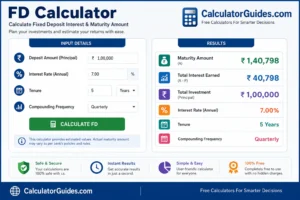
What Is an FD Calculator?
An FD Calculator is an online tool that estimates the maturity value of a fixed deposit.
For example, suppose you deposit:
₹1,00,000
at:
7% annual interest
for:
5 years
The calculator can estimate how much the deposit could be worth at maturity.
The actual bank calculation should always be treated as the final figure.
FD Calculator Formula
For compound interest, a commonly used formula is:
A = P(1 + r/n)^(nt)
Where:
- A = maturity amount
- P = principal/deposit amount
- r = annual interest rate in decimal form
- n = number of compounding periods per year
- t = tenure in years
Interest earned is:
Interest = A − P
For example, a 7% interest rate is entered as:
r = 0.07
FD Calculator Example
Suppose:
Deposit:
₹1,00,000
Interest rate:
7%
Tenure:
5 years
Compounding:
Quarterly
The estimated maturity amount can be calculated using quarterly compounding.
The exact bank maturity amount may differ slightly depending on the bank’s calculation method and product terms.
FD Maturity Amount
The maturity amount is the amount you receive when the fixed deposit completes its tenure, subject to the FD’s terms.
For a cumulative FD:
Maturity Amount = Principal + Interest Earned
For example:
Principal:
₹1,00,000
Interest:
₹40,000
Maturity:
₹1,40,000
This is a simplified illustration.
FD Interest Calculator
An FD calculator can also show the estimated interest earned.
Formula:
Interest Earned = Maturity Amount − Principal
Example:
Deposit:
₹5,00,000
Estimated maturity amount:
₹6,00,000
Estimated interest:
₹1,00,000
FD Interest Rate
The interest rate is one of the most important factors affecting FD returns.
For example, a ₹1 lakh deposit earning 8% will generally produce more interest than the same deposit earning 6%, assuming the same tenure and compounding method.
FD rates vary by:
- Bank
- Tenure
- Customer category
- Deposit type
- Product terms
- Current interest-rate environment
Always check the latest rate directly with the bank before opening an FD.
FD Compounding Frequency
Interest may be compounded according to the terms of the deposit.
Common frequencies include:
- Monthly
- Quarterly
- Half-yearly
- Yearly
For example, with quarterly compounding:
n = 4
With annual compounding:
n = 1
The compounding frequency can affect the calculated maturity amount.
Quarterly Compounding FD
Suppose:
Principal:
₹1,00,000
Annual rate:
8%
Tenure:
3 years
Quarterly compounding means interest is compounded four times per year.
The formula becomes:
A = P(1 + 0.08/4)^(4×3)
The calculator can perform this calculation automatically.
FD Calculator for 1 Year
Suppose:
Deposit:
₹1,00,000
Interest rate:
7%
Tenure:
1 year
The estimated interest will depend on the bank’s compounding and payout method.
A cumulative FD may produce a slightly different maturity value than a simple-interest calculation.
FD Calculator for 3 Years
Suppose:
Deposit:
₹1,00,000
Rate:
7%
Tenure:
3 years
With compounding, the interest earned can itself earn additional interest during the remaining tenure.
Therefore, the maturity amount can be greater than the result from simply multiplying ₹1 lakh by 7% for three years.
FD Calculator for 5 Years
Suppose:
Deposit:
₹1,00,000
Rate:
7%
Tenure:
5 years
The longer tenure gives the interest more time to compound, assuming the deposit rate remains fixed for the entire contracted period.
The calculator can estimate the maturity amount based on the selected compounding frequency.
FD Calculator for ₹5 Lakh
Suppose:
Deposit:
₹5,00,000
Rate:
7%
Tenure:
5 years
The maturity value will depend on the bank’s compounding method and the specific FD product.
The calculator can help you estimate the interest and maturity amount before comparing FD options.
FD Calculator for ₹10 Lakh
Suppose:
Deposit:
₹10,00,000
Rate:
7%
Tenure:
5 years
A higher principal generally produces more interest when the interest rate and tenure remain the same.
However, the applicable deposit limits, insurance coverage, and bank terms should also be considered.
FD Calculator With Monthly Interest
Some fixed deposits allow interest to be paid periodically instead of reinvested.
If interest is paid monthly:
- The interest may not compound in the FD in the same way as a cumulative deposit.
- The bank may calculate interest according to its specific product terms.
- The total cash received can therefore differ from a cumulative FD.
Always check whether the quoted rate is for cumulative or non-cumulative deposits.
Cumulative FD vs Non-Cumulative FD
Cumulative FD
Interest is generally accumulated and paid along with the principal at maturity.
Non-Cumulative FD
Interest is generally paid at regular intervals such as monthly, quarterly, half-yearly, or annually.
| Feature | Cumulative FD | Non-Cumulative FD |
|---|---|---|
| Interest payment | Usually at maturity | Periodically |
| Compounding | Generally applies | Depends on product |
| Regular income | No | Yes |
| Suitable for | Long-term accumulation | Income needs |
The exact features vary by bank.
FD Calculator With Tax
FD interest may be taxable depending on your applicable tax rules.
For an Indian resident, bank FD interest is generally included in taxable income according to the applicable rules.
Your post-tax return can therefore be lower than the headline FD interest rate.
For accurate tax calculations, use the current rules applicable to your income and FD.
FD Interest and TDS
Banks may deduct Tax Deducted at Source (TDS) on FD interest when applicable and when the relevant conditions are met.
TDS is not necessarily the same as your final tax liability.
Your final tax position depends on your total taxable income and applicable tax rules.
Check the latest rules and your bank’s current TDS requirements.
FD Calculator After Tax
Suppose:
FD interest:
₹50,000
and the applicable tax impact is:
₹10,000
A simplified post-tax interest amount would be:
₹40,000
However, actual tax calculations can be more complicated because your FD interest is part of your overall taxable income.
Therefore, do not assume that a simple TDS deduction equals your final tax liability.
FD vs Savings Account
A fixed deposit and savings account serve different purposes.
| Feature | FD | Savings Account |
|---|---|---|
| Interest | Usually fixed for the deposit tenure | Can vary |
| Liquidity | Lower | High |
| Tenure | Fixed | No fixed maturity |
| Early withdrawal | May involve conditions/penalty | Generally available |
| Main purpose | Saving/investment | Everyday banking |
An emergency fund may require more liquidity than a fixed deposit can provide.
FD vs SIP
An FD and SIP are fundamentally different.
FD
- Predetermined interest rate according to product terms
- Lower market-price volatility
- Fixed tenure
- Returns are based on deposit terms
SIP
- A method of investing regularly
- Often used with mutual funds
- Market-linked returns
- No guaranteed return unless the specific product says otherwise
Neither is automatically better for every financial goal.
FD vs Mutual Fund
Fixed deposits and mutual funds have different risk and return characteristics.
| Feature | FD | Mutual Fund |
|---|---|---|
| Return | Based on deposit rate | Market-linked |
| Capital value | Generally stable under deposit terms | Can rise or fall |
| Liquidity | Depends on FD terms | Depends on fund |
| Market risk | Generally lower direct market risk | Market risk applies |
| Guarantee | Depends on institution/product | Not guaranteed |
Choose based on your financial goal, time horizon, liquidity needs, and risk tolerance.
FD and Inflation
An FD may provide a positive nominal return while still producing a low or negative real return after inflation.
For example:
FD rate:
7%
Inflation:
6%
The simplified real return is approximately:
(1.07 ÷ 1.06) − 1
≈ 0.94%
Taxes can reduce the effective after-tax return further.
FD Calculator and Senior Citizens
Many banks offer different interest rates or additional benefits for senior citizens on eligible deposits.
The exact benefit depends on the bank and product.
When comparing an FD, check:
- Standard rate
- Senior-citizen rate
- Applicable tenure
- Maximum additional rate
- Deposit conditions
Do not assume that every bank offers the same senior-citizen benefit.
FD Premature Withdrawal
A fixed deposit is designed for a specified tenure, but some banks allow premature withdrawal subject to their terms.
Possible consequences can include:
- Lower interest rate
- Premature withdrawal penalty
- Different interest calculation
- Other product-specific conditions
Before breaking an FD, check the bank’s current premature-withdrawal policy.
FD Renewal
At maturity, some FDs may be automatically renewed if you have selected an auto-renewal option.
The new interest rate may be different from the original rate.
Therefore, do not assume that an FD will automatically continue at the same interest rate.
FD Laddering
FD laddering means dividing your money across deposits with different maturity dates.
For example:
- ₹1 lakh for 1 year
- ₹1 lakh for 2 years
- ₹1 lakh for 3 years
- ₹1 lakh for 4 years
- ₹1 lakh for 5 years
The exact strategy depends on your liquidity needs and interest-rate expectations.
Laddering can provide regular maturity opportunities instead of locking the entire amount into one deposit.
FD Calculator for Different Interest Rates
Suppose you invest:
₹1,00,000 for 5 years
You can compare different assumed rates:
| Interest Rate | Effect |
|---|---|
| 5% | Lower maturity |
| 6% | Higher than 5% |
| 7% | Higher than 6% |
| 8% | Higher than 7% |
| 9% | Higher than 8% |
The exact maturity values depend on the compounding frequency and bank terms.
How to Use the FD Calculator
Step 1: Enter Deposit Amount
Enter the amount you plan to put into the FD.
Step 2: Enter Interest Rate
Enter the annual FD interest rate.
Step 3: Enter Tenure
Enter the FD duration in years or months.
Step 4: Select Compounding Frequency
Choose the applicable frequency, such as quarterly or annually.
Step 5: Calculate
The calculator can show:
- Principal
- Estimated interest
- Maturity amount
- Total value
Step 6: Compare
Try different rates and tenures to understand how the maturity amount changes.
FD Calculator Formula Summary
Compound Maturity Formula
A = P(1 + r/n)^(nt)
Interest Earned
Interest = A − P
Where:
- A = maturity amount
- P = principal
- r = annual interest rate
- n = compounding periods per year
- t = tenure in years
This formula is a general mathematical model. Banks may use specific calculation conventions for their products.
Common FD Calculation Mistakes
Using the Wrong Interest Rate
Always check the rate applicable to your exact tenure and FD type.
Ignoring Compounding
Cumulative FD returns depend on how interest is compounded.
Confusing Cumulative and Non-Cumulative FD
The payment structure is different.
Ignoring Tax
FD interest can be taxable.
Ignoring Premature Withdrawal Rules
Breaking an FD early may reduce the interest received.
Assuming the Rate Will Stay the Same After Renewal
Renewal rates can change.
Comparing Only the Interest Rate
Also consider tenure, liquidity, tax impact, institution safety, and deposit-insurance limits.
Frequently Asked Questions
What is an FD Calculator?
An FD Calculator estimates the interest and maturity amount of a fixed deposit based on the deposit amount, interest rate, tenure, and compounding frequency.
How is FD interest calculated?
For a compound-interest model, a common formula is:
A = P(1 + r/n)^(nt)
What is the FD maturity amount?
It is the amount payable at maturity according to the FD’s terms, including the principal and applicable interest.
Is FD interest compounded?
It depends on the FD product. Cumulative deposits generally reinvest interest, while non-cumulative deposits typically pay interest periodically.
What is a cumulative FD?
A cumulative FD generally accumulates interest and pays the principal plus accumulated interest at maturity.
What is a non-cumulative FD?
A non-cumulative FD generally pays interest at regular intervals rather than accumulating it until maturity.
Is FD interest taxable?
FD interest may be taxable according to applicable tax laws.
What is TDS on FD interest?
TDS is tax deducted at source by the bank when applicable. It may not represent your final tax liability.
Can I withdraw my FD before maturity?
Some FDs allow premature withdrawal, but the bank may apply a penalty or reduced interest according to its terms.
Does a higher FD rate always mean a better FD?
Not necessarily. Tenure, liquidity, tax, institution risk, and other conditions should also be considered.
Can I use the FD Calculator for monthly-interest FDs?
Yes, but the payout structure must be considered because a non-cumulative FD can produce a different result from a cumulative FD.
Does the FD Calculator include tax?
A basic FD calculator generally shows pre-tax interest unless a tax calculation is specifically included.
Does FD interest beat inflation?
It depends on the FD rate, inflation, and your tax situation. A positive nominal return does not necessarily mean a positive real return.
Is an FD risk-free?
An FD is not completely risk-free. Deposit protection, where applicable, is subject to the relevant country’s rules, limits, and conditions.
Is the FD Calculator accurate?
The mathematical estimate is accurate for the inputs provided, but the bank’s actual maturity calculation and terms should be treated as final.
Is the FD Calculator free?
Yes. The CalculatorGuides.com FD Calculator is free to use.
FD Calculator – Important Things to Remember
Before opening an FD, check:
- Deposit amount
- Interest rate
- Tenure
- Compounding frequency
- Cumulative or non-cumulative option
- Tax and TDS
- Premature withdrawal rules
- Renewal terms
- Deposit-insurance rules
- Liquidity requirements
The highest advertised interest rate is not necessarily the best choice for every investor.
Conclusion
An FD Calculator is a simple way to estimate how much interest you could earn from a fixed deposit and what the approximate maturity amount may be.
The basic compound-interest calculation uses the deposit amount, interest rate, tenure, and compounding frequency. For a cumulative FD, the interest can compound over the investment period, increasing the final maturity amount.
However, the calculator provides an estimate, not a guarantee. Actual returns can depend on the bank’s product terms, interest calculation method, payout option, taxes, TDS, and premature-withdrawal conditions.
When comparing fixed deposits, look beyond the headline interest rate. Consider the tenure, post-tax return, liquidity, renewal terms, and applicable deposit protection as well.
Use the CalculatorGuides.com FD Calculator to estimate your FD interest and maturity amount and compare different deposit scenarios before making a decision.