
Molarity Calculator-Use our free Molarity Calculator to calculate molarity, moles, solute mass, and solution volume. Learn the molarity formula with simple chemistry examples.
Calculated Value: 0🧪 Molarity Calculator | CalculatorGuides
📊 Result
A Molarity Calculator helps you calculate the concentration of a solution using the amount of solute and the total volume of the solution.Molecular Weight Calculator,Ohms Law Calculator.
Molarity is one of the most common concentration units used in chemistry. It is especially useful when working with:
- Laboratory solutions
- Chemical reactions
- Stoichiometry
- Dilutions
- Acid and base solutions
- Solution preparation
- Chemistry experiments
The basic idea is simple: molarity tells you how many moles of solute are present in one liter of solution.
What Is Molarity?
Molarity is the concentration of a solution expressed as moles of solute per liter of solution.
It is represented by:
M
The standard unit is:
mol/L
For example, a 1 M NaCl solution contains:
1 mole of NaCl per liter of solution.
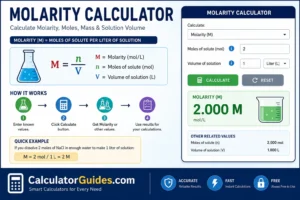
Molarity Formula
The basic formula is:
M = n ÷ V
Where:
- M = molarity in mol/L
- n = moles of solute
- V = volume of solution in liters
The volume must be expressed in liters, not milliliters.
Molarity Example
Suppose you dissolve:
2 moles of NaCl
in a final solution volume of:
1 liter
Then:
M = 2 ÷ 1
= 2 M
The solution has a molarity of:
2 mol/L
Molarity From Grams
If you know the mass of the solute instead of the number of moles, first calculate moles using molar mass.
The formula is:
Moles = Mass ÷ Molar Mass
Then:
Molarity = Moles ÷ Volume
Combining these gives:
M = Mass ÷ (Molar Mass × Volume in liters)
Molarity Example Using Grams
Suppose you dissolve:
58.44 g of NaCl
in enough water to make:
1 L of solution
The molar mass of NaCl is approximately:
58.44 g/mol
Moles:
58.44 ÷ 58.44 = 1 mol
Molarity:
1 ÷ 1 = 1 M
Therefore, the final solution is approximately:
1 M NaCl
Molarity and Milliliters
A common mistake is using milliliters directly in the molarity formula.
Remember:
1 L = 1,000 mL
Therefore:
500 mL = 0.500 L
250 mL = 0.250 L
100 mL = 0.100 L
For example, if you have 0.5 mol of solute in 500 mL:
Convert volume:
500 mL = 0.5 L
Then:
M = 0.5 ÷ 0.5
= 1 M
Calculate Moles From Molarity
If molarity and volume are known, rearrange the formula:
n = M × V
For example:
M = 2 M
V = 0.5 L
Then:
n = 2 × 0.5
= 1 mol
Calculate Volume From Molarity
If you know moles and molarity:
V = n ÷ M
For example:
n = 0.5 mol
M = 2 M
Then:
V = 0.5 ÷ 2
= 0.25 L
or:
250 mL
Molarity Calculation Examples
| Moles | Volume | Molarity |
|---|---|---|
| 1 mol | 1 L | 1 M |
| 2 mol | 1 L | 2 M |
| 1 mol | 2 L | 0.5 M |
| 0.5 mol | 1 L | 0.5 M |
| 0.25 mol | 0.5 L | 0.5 M |
Molarity vs Molality
Molarity and molality are different concentration units.
Molarity
Moles of solute ÷ liters of solution
Unit:
mol/L
Molality
Moles of solute ÷ kilograms of solvent
Unit:
mol/kg
The key difference is that molarity uses the volume of the solution, while molality uses the mass of the solvent.
Molarity vs Concentration
Molarity is one specific way of expressing concentration.
For example:
2 M HCl
means there are approximately:
2 moles of HCl per liter of solution.
Concentration can also be expressed using:
- Mass concentration
- Molality
- Mole fraction
- Percent concentration
- Parts per million
The appropriate unit depends on the application.
Molarity and Dilution
Molarity is frequently used in dilution calculations.
The common dilution relationship is:
M₁V₁ = M₂V₂
Where:
- M₁ = initial concentration
- V₁ = initial volume
- M₂ = final concentration
- V₂ = final volume
This assumes the amount of solute remains constant during dilution.
Dilution Example
Suppose you have:
2 M solution
and want to prepare:
500 mL of a 0.5 M solution
Use:
M₁V₁ = M₂V₂
Therefore:
2 × V₁ = 0.5 × 500
V₁ = 125 mL
So you would measure 125 mL of the original solution and dilute it to a final volume of 500 mL, following appropriate laboratory procedures.
Molarity and Chemical Reactions
Molarity is important in stoichiometry because it connects solution volume to the number of moles participating in a reaction.
For example:
Moles = Molarity × Volume
Once moles are known, the balanced chemical equation can be used to determine the amount of another reactant or product.
Molarity in Acid-Base Chemistry
Molarity is commonly used to describe acid and base solutions.
For example:
0.1 M HCl
means the solution contains approximately:
0.1 mol of HCl per liter of solution.
Molarity can also be used in titration calculations.
For a simple 1:1 reaction, the relationship may reduce to:
M₁V₁ = M₂V₂
but reactions with different stoichiometric ratios require the balanced chemical equation.
Molarity and Titration
In a titration, a solution of known concentration can be used to determine the concentration of an unknown solution.
The calculation depends on the reaction’s stoichiometric ratio.
For a simple 1:1 reaction:
M₁V₁ = M₂V₂
For reactions with other ratios, the mole relationship from the balanced equation must be included.
Molarity of a Solution From Mass
To calculate molarity from mass:
Step 1: Find Molar Mass
Use the chemical formula to determine molar mass.
Step 2: Convert Mass to Moles
Moles = Mass ÷ Molar Mass
Step 3: Convert Volume to Liters
For example:
250 mL = 0.250 L
Step 4: Calculate Molarity
M = Moles ÷ Liters of Solution
Example: 10 g of NaOH
Suppose:
10 g NaOH
is dissolved to make:
500 mL of solution
Molar mass of NaOH is approximately:
40.00 g/mol
Moles:
10 ÷ 40.00 = 0.25 mol
Volume:
500 mL = 0.5 L
Molarity:
0.25 ÷ 0.5 = 0.5 M
Therefore, the solution is approximately:
0.5 M NaOH
What Does 1 M Mean?
A 1 M solution contains:
1 mole of solute per liter of solution.
For example, 1 M glucose means approximately:
1 mole of glucose in every 1 liter of final solution.
It does not mean one mole of solute is necessarily added to exactly one liter of water. The important quantity is the final solution volume.
What Does 0.5 M Mean?
A 0.5 M solution contains:
0.5 mole of solute per liter of solution.
For 2 liters:
0.5 × 2 = 1 mole
So 2 liters of a 0.5 M solution contain 1 mole of solute.
What Does 2 M Mean?
A 2 M solution contains:
2 moles of solute per liter of solution.
For 500 mL:
2 × 0.5 = 1 mole
So 500 mL of a 2 M solution contains approximately 1 mole of solute.
Molarity and Solution Volume
Molarity depends on the final volume of the solution.
This distinction is important.
If you dissolve a substance and then add water until the total volume reaches:
1 L
the calculation uses:
1 L
as the solution volume.
It does not simply use the amount of water initially added.
Common Molarity Calculation Mistakes
Using Milliliters Instead of Liters
Always convert:
mL → L
before applying:
M = n/V
Using Mass Instead of Moles
Molarity requires moles, so convert grams using molar mass first.
Using Solvent Volume Instead of Solution Volume
Molarity is based on the final volume of the solution.
Confusing Molarity With Molality
Molarity uses liters of solution.
Molality uses kilograms of solvent.
Ignoring Significant Figures
The final result should generally reflect the precision of the input measurements.
Molarity Calculator for Chemistry Students
A molarity calculator can be useful for:
- Homework
- Lab reports
- Solution preparation
- Stoichiometry
- Dilution calculations
- Titration problems
- Chemistry exams
- Checking manual calculations
It is still important to understand the underlying formula so you can recognize whether the result makes sense.
How to Use the Molarity Calculator
Option 1: Moles and Volume
Enter:
- Moles of solute
- Volume of solution
The calculator returns molarity.
Option 2: Mass and Molar Mass
Enter:
- Mass of solute
- Molar mass
- Solution volume
The calculator converts mass to moles and calculates molarity.
Option 3: Molarity and Volume
Enter:
- Molarity
- Volume
The calculator can determine the number of moles.
Option 4: Moles and Molarity
Enter:
- Moles
- Molarity
The calculator can determine solution volume.
Frequently Asked Questions
What is a Molarity Calculator?
It is a tool that calculates solution concentration in moles per liter and can also solve for moles, mass, molar mass, or volume depending on the inputs.
What is the formula for molarity?
M = n ÷ V
where volume is measured in liters.
What does M mean in chemistry?
M represents molarity, measured in mol/L.
How do I calculate molarity from grams?
First calculate moles:
Moles = Grams ÷ Molar Mass
Then:
Molarity = Moles ÷ Volume in Liters
How do I convert mL to L?
Divide milliliters by 1,000.
500 mL = 0.5 L
What is 1 M?
A 1 M solution contains approximately 1 mole of solute per liter of solution.
What is the difference between molarity and molality?
Molarity uses moles per liter of solution, while molality uses moles per kilogram of solvent.
Can molarity be greater than 1 M?
Yes. Depending on the substance and solution conditions, concentrations can be greater than 1 M.
Does temperature affect molarity?
Yes. Molarity is based on solution volume, and volume can change with temperature. This means molarity can vary with temperature even when the amount of solute remains unchanged.
Is molarity the same as concentration?
Molarity is one particular unit used to express concentration.
Can I use the Molarity Calculator for dilution?
Yes. Dilution problems can commonly be solved using:
M₁V₁ = M₂V₂
provided the assumptions behind the equation apply.
What is the difference between solute and solvent?
The solute is the substance being dissolved. The solvent is the substance that dissolves it.
Is the Molarity Calculator accurate?
The mathematical calculation is accurate for the values entered. Real laboratory results can vary because of measurement uncertainty, temperature, solution preparation, purity, and other experimental factors.
Is the Molarity Calculator free?
Yes. The CalculatorGuides.com Molarity Calculator is free to use.
Molarity Calculator – Quick Reference
| Calculation | Formula |
|---|---|
| Molarity | M = n ÷ V |
| Moles | n = M × V |
| Volume | V = n ÷ M |
| Moles from mass | n = m ÷ Molar Mass |
| Dilution | M₁V₁ = M₂V₂ |
Remember that volume in the standard molarity formula should be expressed in liters.
Conclusion
The Molarity Calculator provides a quick way to calculate the concentration of a solution and solve related chemistry problems.
The central formula is:
M = n ÷ V
where n is the number of moles of solute and V is the final solution volume in liters.
If you know the mass instead of moles, first calculate:
Moles = Mass ÷ Molar Mass
Then use the molarity formula.
Molarity is widely used in chemistry, laboratory work, stoichiometry, dilution, titration, and solution preparation.
Use the CalculatorGuides.com Molarity Calculator to calculate molarity, moles, solution volume, and related values quickly and accurately.