
Roofing Calculator-Use our free Roofing Calculator to estimate roof area, roofing materials, shingles, bundles, waste, and project cost. Learn how to measure a roof with simple examples.
🏠 Roofing Area Calculator | CalculatorGuides
A Roofing Calculator helps you estimate how much roofing material you may need for a roof project. It can be useful when planning a new roof, replacing an old roof, checking material quantities, or getting a rough idea of roofing costs.All Online Calculators
🛠️ Roofing Material Calculator | CalculatorGuides
Depending on the calculator, you may be able to calculate:
- Roof area
- Roof size
- Roofing squares
- Shingles needed
- Shingle bundles
- Roofing underlayment
- Roof pitch
- Roof waste
- Approximate material cost
- Total roofing cost
- Metal roofing requirements
- Roof coverage
You only need a few basic measurements, such as the length and width of the roof, and sometimes the roof pitch.
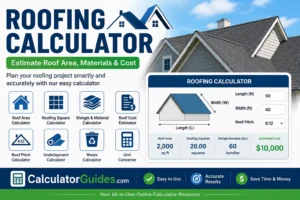
What Is a Roofing Calculator?
A Roofing Calculator is a tool that estimates the size of a roof and the amount of roofing material required.
A simple flat roof calculation starts with:
Roof Area = Length × Width
For a sloped roof, the actual roof surface is larger than the horizontal area. The roof pitch or slope can therefore affect the final material estimate.
For example, a roof section that is:
40 ft long
and:
30 ft wide
has a horizontal area of:
40 × 30 = 1,200 square feet
The actual roofing surface may be larger depending on the roof slope.
Why Use a Roofing Calculator?
Roofing projects can involve a lot of material. A small mistake in estimating the roof area can result in buying too much or too little material.
A roofing calculator can help you:
- Estimate materials before shopping
- Create a rough project budget
- Compare roofing options
- Estimate shingle quantities
- Account for material waste
- Understand roof size
- Prepare questions for a roofing contractor
- Check whether a material estimate looks reasonable
It is best used as a planning tool, not as a replacement for a professional roof measurement.
How to Calculate Roof Area
For a simple rectangular roof section:
Area = Length × Width
For example:
Length = 50 ft
Width = 30 ft
Then:
50 × 30 = 1,500 sq ft
So the horizontal area is:
1,500 square feet
For a sloped roof, you need to account for the slope to estimate the actual roofing surface.
What Is a Roofing Square?
Roofing contractors commonly use a unit called a roofing square.
1 roofing square = 100 square feet of roof area
For example:
2,000 sq ft ÷ 100 = 20 roofing squares
So a 2,000-square-foot roof has:
20 roofing squares
before adding any extra material for waste.
Roofing Square Calculator
The formula is simple:
Roofing Squares = Roof Area ÷ 100
Examples:
| Roof Area | Roofing Squares |
|---|---|
| 1,000 sq ft | 10 |
| 1,500 sq ft | 15 |
| 2,000 sq ft | 20 |
| 2,500 sq ft | 25 |
| 3,000 sq ft | 30 |
| 4,000 sq ft | 40 |
If the roof has a complicated design, the total roof area should be calculated from all roof sections.
How Many Shingles Do I Need?
Most standard asphalt shingles are sold in bundles and are designed to cover a certain amount of roof area.
A common planning estimate is:
3 bundles ≈ 1 roofing square
However, coverage varies by shingle product, so always check the manufacturer’s packaging.
For example, if your roof requires:
20 squares
and the product covers approximately:
1 square per 3 bundles
you may need around:
20 × 3 = 60 bundles
This is only a basic estimate. Starter shingles, ridge caps, cutting waste, and the specific product can change the actual quantity.
How Much Extra Roofing Material Should I Add?
Roofing materials are rarely installed with zero waste.
Extra material may be needed because of:
- Cutting
- Overlapping
- Roof valleys
- Dormers
- Hips and ridges
- Roof shape
- Damaged pieces
- Installation mistakes
A common planning allowance is around 10% to 15%, but the appropriate amount depends on the roof design and material.
For a simple roof:
Roof Area × 1.10
can represent a 10% allowance.
For example:
2,000 × 1.10 = 2,200 sq ft
The actual allowance should be based on the roofing material and roof complexity.
Roofing Calculator With Waste
Suppose your calculated roof area is:
2,000 sq ft
and you want to allow:
10% waste
Waste:
2,000 × 10% = 200 sq ft
Estimated material coverage:
2,000 + 200 = 2,200 sq ft
So you would plan for approximately:
2,200 sq ft of coverage
How Does Roof Pitch Affect Roof Area?
Roof pitch describes how steep a roof is.
It is commonly written as:
6:12
This means the roof rises:
6 inches
for every:
12 inches of horizontal distance
A steeper roof has more actual surface area than the same-size low-slope roof when measured from above.
This is why a roofing calculator may ask for the roof pitch.
Common Roof Pitch Examples
| Roof Pitch | Description |
|---|---|
| 2:12 | Low slope |
| 3:12 | Low slope |
| 4:12 | Moderate slope |
| 5:12 | Moderate slope |
| 6:12 | Common residential slope |
| 8:12 | Steeper roof |
| 10:12 | Very steep |
| 12:12 | 45-degree slope |
Different roofing materials have different minimum slope requirements, so pitch should be considered when selecting a roofing product.
Roof Pitch Calculator
If you know the roof rise and run, you can determine the pitch.
For example:
Rise = 6 inches
Run = 12 inches
The pitch is:
6:12
If the rise is:
8 inches
for every:
12 inches
the pitch is:
8:12
Roof pitch can also be measured using specialized tools.
Roof Pitch and Roofing Material
Roof pitch matters because it can affect:
- Roof surface area
- Material requirements
- Installation method
- Drainage
- Safety
- Labor requirements
A very steep roof can also be more difficult and dangerous to work on.
For actual installation, follow the roofing manufacturer’s requirements and local building codes.
Gable Roof Calculator
A gable roof has two main sloping sides.
For a basic gable roof, calculate each roof plane separately and add them together.
For example:
Left roof section:
1,000 sq ft
Right roof section:
1,000 sq ft
Total:
2,000 sq ft
Then add an appropriate waste allowance.
Hip Roof Calculator
A hip roof slopes on multiple sides rather than having two simple gable ends.
Because of the additional roof sections, hips and valleys can increase cutting and material waste.
A hip roof calculator can provide a useful estimate, but a detailed measurement is better for an actual roofing order.
Flat Roof Calculator
Flat and low-slope roofs are often calculated using the roof’s length and width.
For example:
40 ft × 25 ft
= 1,000 sq ft
However, “flat” roofs usually have some slope for drainage, even when they appear flat.
The roofing system must be appropriate for the actual slope and building design.
Metal Roofing Calculator
A roofing calculator can also help estimate metal roofing materials.
For metal roofing, you may need to consider:
- Roof area
- Panel width
- Panel length
- Panel overlap
- Number of panels
- Trim
- Fasteners
- Ridge caps
- Valleys
- Waste
Metal roofing products vary significantly, so panel coverage should come from the specific manufacturer’s specifications.
Roofing Underlayment Calculator
Underlayment is installed beneath many roofing systems.
To estimate the amount needed, start with the roof area and then account for overlap and installation requirements.
For example, if your roof is:
2,000 sq ft
you may need more than exactly 2,000 sq ft of underlayment because rolls overlap and edges may require additional material.
Always check the coverage printed on the roll.
Roofing Cost Calculator
A roofing calculator can also provide a rough estimate of project cost.
A simple estimate is:
Total Cost = Roof Area × Cost Per Square Foot
For example:
2,000 sq ft
at an assumed cost of:
$5 per sq ft
would give:
2,000 × $5 = $10,000
This is only a mathematical example.
Actual roofing prices vary based on:
- Roofing material
- Labor
- Roof pitch
- Roof accessibility
- Roof design
- Tear-off requirements
- Location
- Building height
- Underlayment
- Flashing
- Ventilation
- Permits
- Disposal fees
Roofing Cost Per Square
Roofing contractors may quote prices per roofing square rather than per square foot.
Remember:
1 roofing square = 100 sq ft
For example, if a project costs:
$600 per square
and the roof requires:
20 squares
then:
20 × $600 = $12,000
This is only an example. Actual contractor pricing can be very different.
Roof Replacement Cost
Replacing a roof can involve more than installing new shingles.
The total project may include:
- Old roof removal
- Disposal
- Deck inspection
- Deck repairs
- Underlayment
- New roofing
- Flashing
- Drip edge
- Ventilation
- Ridge caps
- Labor
- Cleanup
This is why a simple roof-area calculation cannot provide an exact replacement price.
How Many Roofing Materials Do I Need?
The exact quantity depends on the material.
A roofing project may require:
Shingles
Main roof covering.
Starter Shingles
Used along roof edges where required by the roofing system.
Ridge Cap
Installed along ridges.
Underlayment
Provides an additional layer below the roof covering.
Flashing
Helps protect areas where the roof meets walls, chimneys, skylights, and other structures.
Drip Edge
Helps manage water at roof edges.
Fasteners
Used to attach roofing materials according to manufacturer requirements.
Roofing Calculator Tips
Measure Every Roof Section
Don’t assume the entire roof is one rectangle.
Break complicated roofs into smaller sections.
Measure Carefully
Small measurement errors can become significant when multiplied across a large roof.
Check the Roof Pitch
A roof’s slope affects the actual surface area.
Add Appropriate Waste
Complex roofs usually require more cutting and may need a larger allowance.
Check Product Coverage
Never assume every shingle bundle or metal panel covers exactly the same area.
Use Manufacturer Information
The packaging and installation instructions provide the most reliable product-specific coverage information.
Get a Professional Measurement
For a real roof replacement, use a professional roof measurement or contractor estimate before ordering expensive materials.
Features of a Roofing Calculator
A useful roofing calculator may include several tools in one place.
Roof Area Calculator
Calculate the basic roof area from dimensions.
Roofing Square Calculator
Convert square feet into roofing squares.
Shingle Calculator
Estimate the number of shingle bundles.
Roof Pitch Calculator
Work with roof rise and run.
Waste Calculator
Add an allowance for cutting and installation waste.
Roofing Cost Calculator
Estimate project cost from area and price.
Material Calculator
Estimate additional roofing materials.
Unit Conversion
Convert between:
- Feet
- Inches
- Meters
- Centimeters
- Square feet
- Square meters
Roofing Calculator Example
Let’s use a simple example.
Suppose a roof has:
Length = 50 ft
Width = 40 ft
Basic roof area:
50 × 40 = 2,000 sq ft
Roofing squares:
2,000 ÷ 100 = 20 squares
If you allow 10% extra:
2,000 × 1.10 = 2,200 sq ft
So your basic planning estimate is:
2,200 sq ft of material coverage
The actual quantity of shingles, underlayment, ridge caps, and other materials should be calculated using the specific roofing product and roof design.
Can I Use a Roofing Calculator for My House?
Yes, you can use one to get a rough estimate.
You will normally need:
- Roof length
- Roof width
- Roof pitch
- Number of roof sections
- Material type
- Waste allowance
For a simple roof, this can give you a useful starting point.
For a complicated roof, professional measurements are recommended.
Roofing Calculator for New Roofs
If you’re planning a new roof, calculate the roof area first.
Then consider:
- Roofing material
- Roof pitch
- Waste
- Underlayment
- Flashing
- Ridge and hip materials
- Ventilation
- Labor
- Removal and disposal
This gives you a better picture of the total project rather than looking only at shingle cost.
Roofing Calculator for Roof Replacement
For roof replacement, the existing roof can affect the final cost.
For example, additional work may be required if:
- The decking is damaged
- Existing roofing must be removed
- Flashing needs replacement
- Ventilation needs improvement
- The roof has complicated sections
A calculator can estimate quantities, but it cannot see hidden damage beneath the existing roof covering.
Roofing Calculator vs Professional Estimate
A calculator provides an estimate based on the information you enter.
A roofing professional can inspect:
- Roof condition
- Decking
- Flashing
- Ventilation
- Drainage
- Roof access
- Existing materials
- Structural issues
For a real roofing project, use the calculator as a planning tool and get a professional quote before making a final decision.
Frequently Asked Questions
What is a Roofing Calculator?
A Roofing Calculator estimates roof area, roofing squares, material quantities, waste, and sometimes project cost.
How do I calculate roof area?
For a simple rectangular section:
Length × Width
For sloped roofs, the actual roof surface and pitch need to be considered.
How many square feet are in a roofing square?
1 roofing square = 100 square feet.
How many shingles are in a roofing square?
A common estimate is 3 bundles per roofing square, but coverage varies by product. Always check the manufacturer’s specifications.
How much roofing waste should I add?
A common planning allowance is around 10% to 15%, but the correct amount depends on roof complexity and material.
Does roof pitch affect the amount of material I need?
Yes. Roof pitch affects the actual roof surface area and can also affect installation requirements.
How do I calculate roofing cost?
A basic estimate is:
Roof Area × Cost Per Square Foot
Actual project cost can include many additional expenses.
What is the difference between roof area and roofing squares?
Roof area is usually measured in square feet or square meters. A roofing square is a roofing industry unit equal to 100 square feet.
Can I calculate shingles with this calculator?
Yes, if the calculator includes shingle coverage. Remember that different products have different coverage rates.
Can I use the calculator for a metal roof?
Yes, for a basic material estimate. Metal panel width, overlap, panel length, trim, and manufacturer specifications should also be considered.
Can I calculate a hip roof?
Yes, but a hip roof usually requires more measurements because it has multiple sloping sections.
Can I calculate a gable roof?
Yes. Measure each roof plane and add the areas together.
Does a flat roof have zero slope?
Not necessarily. Many flat-roof systems have a small slope to help water drain.
Can a Roofing Calculator give an exact quote?
No. It can provide an estimate based on your inputs. Actual roofing costs depend on the roof, materials, labor, location, and site conditions.
How accurate is a Roofing Calculator?
The mathematical calculation can be accurate, but the final estimate is only as accurate as the measurements, roof dimensions, pitch, material coverage, and waste allowance entered.
Should I add extra shingles?
Usually, some extra material is useful because cutting and installation create waste. The appropriate amount depends on the roof and product.
Can I use square meters instead of square feet?
Yes, as long as all measurements and material coverage use consistent units.
Roofing Calculator – Quick Reference
| Calculation | Formula |
|---|---|
| Basic Roof Area | Length × Width |
| Roofing Squares | Area ÷ 100 |
| Material With 10% Waste | Area × 1.10 |
| Material With 15% Waste | Area × 1.15 |
| Basic Roofing Cost | Area × Cost Per Sq Ft |
| Basic Shingle Estimate | Roofing Squares × Bundles Per Square |
Final Thoughts
A Roofing Calculator is a useful starting point when you want to understand the size of a roof and estimate how much material may be required.
Start with the roof dimensions, calculate the area, convert the result into roofing squares, and then account for roof pitch, material coverage, and waste.
For example, a 2,000 sq ft roof equals:
20 roofing squares
With a 10% planning allowance:
2,200 sq ft
But the final material order should always be based on the exact roof design and the coverage information for the roofing product you plan to use.
Use the CalculatorGuides.com Roofing Calculator to quickly estimate roof area, roofing squares, shingles, waste, materials, and basic project costs before getting a professional roofing estimate.